

Arrow Electronics and Avnet: Latest Results Surpass US$10 Billion, Hitting New Highs!
01 Quarterly Revenue of Both Companies Tops US$10 Billion
In 2025, as demand in major markets such as Europe and the United States gradually recovered, Arrow Electronics and Avnet began to see their performance rebound. Entering 2026, the two companies’ growth momentum further strengthened.
Arrow’s revenue growth in the first three quarters reached 39%, 32%, and 39% year on year, respectively, maintaining strong growth. Avnet’s revenue in FY2026 Q3, FY2026 Q4, and FY2027 Q1 grew 34.0%, 47.7%, and 81.7% year on year, respectively, sustaining continuous growth.
Let’s first look at Arrow.
Arrow’s third-quarter total revenue reached US$10.718 billion, up 39% year on year, setting a new quarterly revenue high and exceeding the upper end of its previously provided guidance.
Its two major businesses grew in tandem:
● Global Components revenue was US$7.943 billion, up 43% year on year;
● Global Enterprise Computing Solutions (Global ECS) revenue was US$2.775 billion, up 29% year on year.
In terms of business mix, Global Components remained Arrow’s largest revenue source, accounting for about 74% of total revenue; ECS accounted for about 26%.
By region, all three regions of Global Components achieved growth: the Americas grew 58% year on year, EMEA grew 41%, and Asia-Pacific grew 33%. For ECS, sales in EMEA rose 30% year on year, while the Americas grew 27%.
It is clear that Arrow’s growth this quarter was not driven by a single region or business, but by simultaneous growth across both major businesses and multiple regions.
Arrow’s adjusted net profit for the third quarter was US$321 million, up 155% year on year. Adjusted gross margin was 10.8%, flat compared with the same period last year.
Now let’s look at Avnet.
Avnet reported total revenue of US$10.718 billion for the first quarter of fiscal 2027, up 81.7% year on year and 29.2% quarter on quarter. Excluding the impact of the extra week, revenue grew 70.6% year on year and 21% quarter on quarter.
In terms of business, Electronic Components (EC) revenue was US$10.135 billion, up 84.3% year on year; Farnell revenue was US$583 million, up 46.2% year on year.
By region, all three major regions achieved year-on-year and quarter-on-quarter growth.
Asia remained Avnet’s largest market, with revenue of US$5.119 billion, up 78.8% year on year, accounting for about 47.8% of total revenue; the Americas generated revenue of US$2.862 billion, up 108.9% year on year; EMEA revenue was US$2.738 billion, up 64.3% year on year.
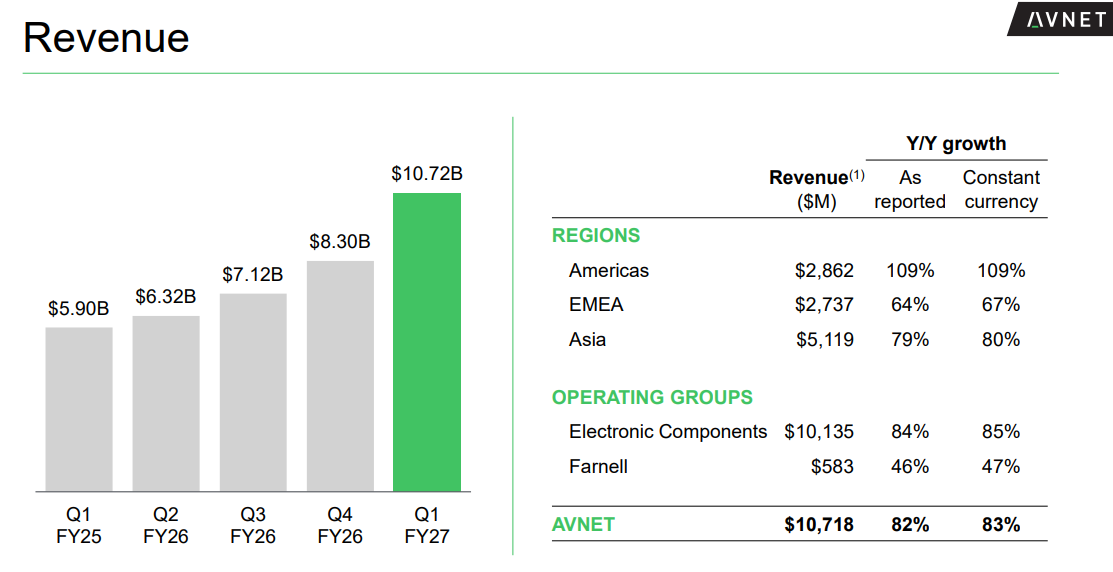
In terms of profit, Avnet’s adjusted operating income was US$498 million, up 230.5% year on year. The operating margin of Avnet’s Electronic Components business reached 4.8%, up 189 basis points year on year; Farnell’s operating margin reached 10.1%, returning to double-digit levels for the first time in more than three years.
However, Avnet’s gross margin was 10.0%, down about 40 basis points year on year, mainly due to changes in product and customer mix.
02 What Are the Growth Highlights? Memory Price Increases, AI Demand, and Lead-Time Changes
Several common market signals in the two companies’ latest financial reports and earnings calls are worth watching.
First, memory price increases have become an important driver of revenue growth.
Arrow said that Global Components growth in the third quarter was driven both by broad underlying shipment demand and by price increases for some products, with memory products among the categories showing relatively obvious price increases.
Management specifically noted that price increases made a notable contribution to the components business’s revenue growth in the third quarter. If the company could obtain more product supply, it could also achieve more shipments.
Avnet said that the magnitude of memory price increases in the current quarter was roughly similar to the previous quarter.
Therefore, whether quarter on quarter or year on year, about one-third of sales growth was attributable to price increases in memory products.
From the perspective of application markets, demand is spreading to more areas.
Arrow’s ECS business revenue grew 29% year on year in the third quarter. The company said continued growth in demand for AI, cloud computing, cybersecurity, and hybrid cloud infrastructure drove increases in ECS orders and backlog.
Avnet emphasized that as AI servers, processors, and data center construction increase, new demand will also arise for power supplies, passive components, connectors, and other semiconductor products. Data centers, aerospace and defense, and networking and communications were standout markets this quarter. Among them, interconnect, passive, and electromechanical components (IP&E) sales were close to US$1.7 billion this quarter, already exceeding US$6 billion on an annualized basis.
Lead times continue to lengthen, and tightening supply is beginning to spread to more categories.
Arrow said that lead times for its Global Components business lengthened further in the third quarter but remain significantly below previous highs. At the same time, the Global Components book-to-bill ratio was clearly above 1, and backlog continued to increase, now extending into mid-2027.
Management believes that market demand is not growing only in memory and computing; core end markets such as industrial, transportation, aerospace and defense are also growing. In particular, in markets such as robotics, power conversion, energy, and automation, the company’s sales are growing rapidly quarter on quarter, and backlogs in these areas are also increasing.
Avnet said the supply environment continued to tighten this quarter, with lead-time extensions already affecting most semiconductors and IP&E products. In addition to memory, products such as power supplies, MLCCs, discrete devices, and controllers have also begun to see longer lead times.
Avnet’s book-to-bill ratio was above 1 in all regions, and backlog continued to grow. However, as lead times lengthen, the number of delayed orders is also increasing, and the company is closely monitoring this change.
Inventory is rising at both companies.
Arrow’s inventory reached US$7.31 billion at the end of the third quarter, up US$1.42 billion quarter on quarter. Of this, about US$600 million was related to the AIS (Arrow Intelligent Solutions) business, preparing computing and storage equipment in advance for subsequent large AI infrastructure orders. This inventory is mainly intended for the assembly, testing, and delivery of future orders, rather than simply passive stockpiling.
Arrow’s inventory turnover days were 70, an increase of 9 days from the previous quarter and 7 days from the same period last year.
At Avnet, ending inventory in FY2027 Q1 increased by about US$2.1 billion quarter on quarter. The CFO explained that this inventory increase mainly came from three aspects: higher inventory value due to price increases in memory-related products, inventory investment in the supply chain services business, sales growth, and timing differences in inventory arrivals at quarter-end. In terms of inventory turnover, Avnet’s inventory days were 72, basically flat quarter on quarter.
Both companies also offered their views on future price trends.
Arrow said that price increases from most suppliers had already begun to show up in the third quarter, and it expects growth in its Global Components business in the fourth quarter to be driven mainly by actual shipment volumes rather than continued significant price increases.
Avnet said price increases are gradually spreading from memory to other electronic component categories, and it expects more price adjustments next year.
03 Conclusion
Judging from their latest guidance, both companies remain relatively optimistic about growth in the next quarter. Arrow expects fourth-quarter 2026 revenue of US$11.55 billion to US$12.15 billion, while Avnet expects second-quarter fiscal 2027 revenue (ending January 2, 2027) of US$11.1 billion to US$11.4 billion. For the “two A’s,” the direction of recovery is becoming increasingly clear.


 Whatsapp
 Email
 Skype