
The "Heart" of Yadea and Aima to Go Public! Fujian-Born Founder Hits 2 Billion Yuan Annual Revenue, With Lei Jun Backing Him
01
Supplier to Yadea and Aima: Maker of the "Heart" of Electric Scooters Posts 2 Billion Yuan in Annual Revenue
This business is underpinned by a product matrix spanning key components to system integration. Smart controllers constitute its absolute mainstay; related revenue rose from 1.19 billion yuan to 1.882 billion yuan, while their share of core operating revenue declined from 97.35% to 91.71%.
Among its end customers, Yadea and Aima follow a mass-market volume-and-price strategy, whereas Segway-Ninebot and NIU focus on premium smart models that impose higher requirements on controller computing power and response speed. The latter group represents the fastest-growing buyers of Gobel’s enhanced computing-power controllers. Revenue from such products for high-end vehicles jumped from 110 million yuan to 467 million yuan over three years.
In other words, a considerable share of the “brains” inside electric two-wheelers you see on the streets are manufactured in Songshan Lake. This, however, also leaves Gobel with relatively high customer concentration. During the reporting periods, sales revenue from its top five customers accounted for as much as 86.85%, 76.89% and 65.55% of its core operating revenue respectively.
E-bike electric drive systems and integrated solutions form its second growth curve. Revenue from this segment climbed from 32.44 million yuan to 156 million yuan, with its revenue share rising from 2.65% to 7.59%.
Technologically, the company boasts solid capabilities. During the reporting periods, its R&D expenses stood at 67.56 million yuan, 68.98 million yuan and 89.37 million yuan respectively. R&D personnel account for half of its total workforce. As of the end of March 2026, it held 227 domestic patents, 23 overseas patents and 62 software copyrights. As a major drafting organization, it has participated in the formulation of more than 10 national and industrial standards.
Gobel is one of China’s early enterprises to introduce automotive management systems into the manufacturing of controllers for short-distance mobility vehicles. It has launched premium controllers featuring the industry’s highest power density and IPX7 waterproof rating.
On the E-bike second growth curve, Hepha, its proprietary complete vehicle brand, has entered markets including Germany, France and Austria. Its mid-drive motors have secured orders from overseas OEMs such as Aventon, Tarran and MILOO. Even so, this business segment generated revenue of only 156 million yuan in 2025, not yet large enough to subsidize its core business.
Turning to its Prospectus, the company boasts an impressive performance trajectory. From 2023 to 2025, operating revenue rose from 1.248 billion yuan to 1.436 billion yuan and further to 2.071 billion yuan, representing a year-on-year revenue growth of 44.27% in 2025. Net profit attributable to parent company climbed from 84.81 million yuan to 93.88 million yuan and then to 183 million yuan, nearly doubling in 2025.
Headquartered in Songshan Lake, Dongguan, the company’s production base covers a construction area of over 40,000 square meters and employs nearly 2,000 staff. It operates delivery centers in Tianjin, Wuxi, Chongqing and Taizhou, together with subsidiaries in Germany, Singapore and Indonesia.
The intended use of raised funds is also specified in the Prospectus. Out of the total 1.05 billion yuan to be raised, 240 million yuan will be allocated for production base construction, 286 million yuan for the industrialization of E-bike mid-drive systems, 283 million yuan for the construction of headquarters and R&D center, 88.25 million yuan for marketing network development, and 150 million yuan for working capital replenishment. At this point, the story fits the classic profile of a hidden champion.
02
The Flip Side of No.1 Market Share: Acceptance Bills Equal 80% of Revenue
Yet for this globally top-ranked firm whose performance has doubled over three years, the hard cash on its books has failed to grow alongside its revenue. The issue lies in the form of payment collection.
As of the end of 2025, the book balance of the company’s accounts receivable rose from 260 million yuan in 2023 to 449 million yuan, while allowance for bad debts increased from 13.02 million yuan to 25.10 million yuan.
When issuing its audit report, RSM China Certified Public Accountants identified impairment of accounts receivable as a key audit matter, on the grounds that accounts receivable represented a material amount and impairment testing involved significant management judgment.
Notes receivable and receivables financing are classified as current assets together with accounts receivable. At year-end 2023 to 2025, the combined carrying value of accounts receivable, notes receivable and receivables financing stood at 314 million yuan, 351 million yuan and 558 million yuan respectively. Their proportion in current assets climbed from 30.50% to 48.03%.
This means nearly half of the company’s current assets are recorded on the books in the form of notes and receivables — visible on financial statements but not readily convertible into cash in the short term.
Receivables are not the only pressure point squeezing the business. The carrying value of inventory rose from 161 million yuan to 331 million yuan, and inventory turnover dropped from 5.88 times to 4.65 times. Raw materials account for nearly half of total inventory; chips and metal materials face dual risks of technological obsolescence and price decline.
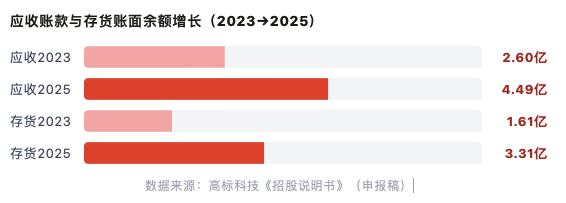
Accounts receivable and inventory together tie up working capital substantially, forcing the company to borrow funds for operational turnover. This is the fundamental reason why it boasts solid book profits yet faces tight cash flow.
In addition, as disclosed in the Prospectus, during the reporting periods, the amounts of Gobel’s accounts receivable converted into bank acceptance bills reached 1.177 billion yuan, 1.184 billion yuan and 1.696 billion yuan respectively. Against core operating revenue of 1.223 billion yuan, 1.416 billion yuan and 2.052 billion yuan for the corresponding years, the ratios stood at 96.27%, 83.61% and 82.66%.
| Item | Year 2025 | Year 2024 | Year 2023 |
|---|---|---|---|
| Accounts Receivable Converted to Bank Acceptance Bills | 169,600.06 | 118,416.32 | 117,737.49 |
| Total | 169,600.06 | 118,416.32 | 117,737.49 |
Source: "Response Letter"
Downstream vehicle manufacturers are generally in a strong bargaining position. They tend to defer payments and settle via bills. Such credit purchases pass the burden of capital occupation upstream to component suppliers along the supply chain. When the company sells high-spec controllers to clients such as Yadea and Aima, what it receives in return is often not cash on bank deposit, but bank acceptance bills.
Prior to bill maturity, these instruments are recorded as Notes Receivable or Financing from Receivables, and do not count as cash inflows from operating activities. If the company chooses to discount the bills at banks to obtain cash ahead of maturity, the proceeds from discounting are classified as cash inflows from financing activities under accounting standards, and likewise excluded from operating cash flow.
The consequences are directly reflected in the statement of cash flows. From 2023 to 2025, the net cash flow generated from operating activities stood at RMB 158 million, RMB 38.98 million and RMB 19.35 million respectively, shrinking year by year. Meanwhile, net profit attributable to parent company rose from RMB 84.81 million to RMB 183 million.
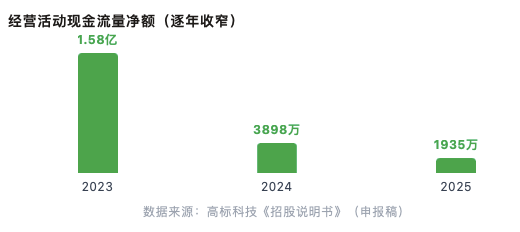
When comparing the two metrics, the cash-to-profit ratio dropped from 1.86x to 0.11x. For a company with annual revenue of RMB 2 billion and a net profit of nearly RMB 183 million, the actual cash inflow from operating activities at year-end was less than RMB 20 million.
Cash and cash equivalents at the end of the period shrank from RMB 221 million in 2023 to RMB 60.38 million in 2024, before rebounding to RMB 85.37 million in 2025. Even so, the balance was still insufficient to cover its short-term borrowings of RMB 94.69 million and current portion of non-current liabilities of RMB 4.02 million for the year.
Turning to its peers, similar pressures are evident. Xiechang Technology is a listed player in the same sector. Its annual report states that amid fierce market competition, the unit price of its controller products declined. The gross profit margin of its motion controllers fell to approximately 11.76% in 2025, while Gaobiao maintained a margin of 23.97% over the same period, retaining its competitive edge.
This indicates that Gaobiao’s technological positioning within the industrial chain remains solid. Nevertheless, the threat of price competition is looming. Leading complete-vehicle customers are also developing controllers in-house, adopting a dual-track strategy combining external procurement and self-development to check and balance their suppliers.
The prospectus offers its own explanation for weakening cash flow, attributing it mainly to rapid business expansion that increased working capital occupation by accounts receivable, inventory and other items, alongside the large volume of bill settlements. The company also disclosed cash obtained through discounting non-6+9 bank acceptance bills received, amounting to RMB 5.7856 million, RMB 20.9236 million and RMB 103 million over the three years respectively.
03
The founder holds more than 80% of the voting rights; Shunwei and Boyu are shareholders.
Chen Qingfu, an engineer with a technical secondary school education background, built Gaobiao into the world’s No.1 player. Born in Fujian in 1978, he worked as an R&D engineer at Shenzhen Zhongtianxin Electronics from 1997 to 1999, and then served as both R&D engineer and sales engineer at Shenzhen Shengbiao Electronics between 2000 and 2002.
Back in 2002, the micro-mobility market was still dominated by motorcycle anti-theft alarms. Chen Qingfu started his business with anti-theft alarm products. Three years later, he integrated anti-theft functions and motor control circuits into a single module, placing an early bet on the upcoming boom of electric vehicles.
In 2005, Gaobiao launched the world’s first electric vehicle controller integrating anti-theft and motor control functions, marking its entry into the micro-mobility controller track. Later, he attended the Executive Master of Business Administration (EMBA) program at Tsinghua Shenzhen International Graduate School and the EMBA program of Cheung Kong Graduate School of Business. In 2023, he was awarded the title of Outstanding Young Private Entrepreneur of Dongguan, and also serves as Honorary President of the Songshan Lake Dongguan Chamber of Commerce Federation.
Chen Qingfu maintains highly concentrated control over Gaobiao. He directly holds 10.82% of the Company’s shares. Through Gaobiao Jishi, an entity he wholly owns, he controls 51.71% of voting rights. In addition, as the general partner of Gaobiao Employee Shareholding Platforms No.1 through No.10, he controls another 19.50% of voting rights. In aggregate, he commands **82.03% of the voting rights**.
In 2025, his remuneration stood at RMB 2.5718 million, ranking first among the company’s directors, supervisors and senior management. Upon listing on the ChiNext Market, the shares corresponding to this 82% voting stake will see a paper revaluation, with the magnitude of his net worth determined by the offering price.
The round of financing in May 2023 brought in external capital. Investors including Boyu Fund IV, Advanced Manufacturing Industry Investment Fund Phase II, Weifang Qingxin Huaping, Guangzhou Chufeng, Shenzhen Shunying, Tianjin Haihe Shunke, Dongguan Innovation Investment, together with individual shareholder Huang Yizhou, made concentrated equity subscriptions.
According to Tianyancha, this financing round brought in institutional investors including Boyu Capital, SDIC Venture Capital, Shunwei Capital, West Summit Capital and Dongguan Financial Holdings. Shunwei Capital was co-founded in 2011 by its key principals Lei Jun and Xu Dalai, with Lei Jun serving as Chairman and Xu Dalai as CEO. The financing coincided with a milestone for the company: revenue reached RMB 1.248 billion and net profit hit RMB 84.81 million. Institutional investors stepped in on the eve of the company’s performance takeoff.
As such, Gaobiao’s capital structure forms a three-tier framework. At the top tier sits the holding platform wholly owned by Chen Qingfu via Gaobiao Jishi. The middle tier is the incentive layer, where senior management and core employees subscribe through Gaobiao Employee Shareholding Platforms No.1 to No.10. The bottom tier comprises external financial and industrial capital that entered collectively in 2023.
Building a global leader over twenty-three years, Chen Qingfu has proven he can sell controllers worldwide. Post-IPO, he faces another test: converting the pile of acceptance bills on the books into freely deployable cash in corporate bank accounts. What else do you know about Gaobiao’s story? Feel free to leave your comments below.


 Whatsapp
 Email
 Skype