

In a Corner No One Noticed, Sony CMOS Has Been Out of Stock for Nearly a Year
01 Sony CMOS Is in Short Supply
Recently, there has been noticeably more chatter about Sony CMOS in the spot market.
On one hand, Sony recently issued planned discontinuation notices for a batch of traditional 2MP security CMOS products. As news of the discontinuation spread, market prices for some related components have risen.
On the other hand, we recently asked several market sources, and almost all the feedback we got was that Sony parts are noticeably harder to get this year than last year.
Someone recently received a batch of overseas machine vision demand, but sourcing the parts has not been smooth. “Some parts were still available, but two days later they were gone.” His feeling was: “High-end parts are hard to get, but for consumer-grade ones, if you scrounge around, you can still scrape together enough.”
A friend who mainly deals in various CMOS products said that Sony’s overall supply was still fairly normal last year, but it has become noticeably tighter this year. On one hand, demand has increased; on the other hand, supply has not fully kept up, and with upstream materials also tight, delivery for some products has begun to be affected. In particular, after Sony recently issued discontinuation notices, inquiries for some older models have clearly increased. “Prices for discontinued components will definitely rise, and more customers are coming to ask, but the problem is we have no stock to give them.”
Another friend who mainly focuses on Sony CMOS said that the strongest demand he is currently seeing is mainly concentrated in industrial-grade products, including applications such as artificial intelligence, robotics, and industrial cameras (machine vision).
He said, “Sony’s supply probably started to tighten after this year’s May Day holiday. Lead times quoted for industrial-grade components are now more than eight months, and for some security components, even more than 15 months.” According to his understanding, new orders for this year can no longer be added to the schedule for now, and they will have to wait until the factory rearranges capacity around next year’s New Year.
For end customers, however, switching to alternative components is not as easy as one might think. CMOS is not something that can be directly replaced simply by swapping in a chip with the same pinout. In many cases, it also involves ISP tuning, lens matching, PCB, firmware, software, and re-testing and certification. So even though lead times are already long, unless absolutely necessary, customers often still keep looking for the original components.
Regarding that earlier batch of overseas machine vision demand, he said, “This kind of demand exists both domestically and overseas, but there is a shortage overall. Overseas itself has little spot stock, while China is the largest spot inventory market, and now there isn’t much stock here either.”
So here comes the question: Why have Sony CMOS parts suddenly become so hard to get this year?
02 Why Has Sony CMOS Supply Become So Tight?
Behind the tightening supply of Sony CMOS, several noteworthy clues can be found. Possible causes include upstream raw material supply, the original manufacturer’s inventory and capacity, and issues with the sales channel structure.
First, let’s look at upstream raw materials. The first issue to attract attention is the supply of high-end glass fiber cloth such as T-Glass.
In its March 2026 supply chain report, Fusion Worldwide mentioned that the Sony IMX series was expected to experience supply tightness starting in April, one reason being constrained supply of high-end T-Glass glass fiber cloth from Nittobo. By June, Fusion further noted that industrial and automotive-related part numbers such as IMX250LLR, IMX178LQJ, IMX264LLR-C, IMX253LLR, and IMX546-AAQJ were under supply pressure, still related to constrained supply of Nittobo materials.
The global high-end T-Glass glass fiber cloth landscape is highly concentrated. According to TrendForce data, Nittobo alone accounts for about 90% of the global market share. AI servers have increased consumption of high-end fiberglass cloth, and Nittobo’s capacity expansion will not significantly ease the situation until 2027.
Next, let’s look at Sony’s own inventory and capacity.
Sony’s image sensor business has continued to expand its sales scale in recent years, growing from 1.26 trillion yen in FY22 to 1.98 trillion yen in FY25. Smartphones remain the largest segment, but other applications such as automotive, industrial, and security are growing faster, with sales nearly doubling over three years. Sony has also repeatedly listed the trend toward larger sensors in high-end smartphones, multi-camera adoption in vehicles, and expansion of industrial applications as important growth directions for its image sensor business.
Let’s put several sets of officially disclosed data together and focus mainly on the I&SS (Imaging & Sensing Solutions) segment.
Sony’s I&SS inventory declined steadily from JPY 712.9 billion in FY25 Q1 to JPY 606.8 billion in FY25 Q4, a decrease of about 14.9% over the full FY25.
Over the same period, Sony’s image sensor sales were growing. Full-year FY25 Image Sensor sales reached JPY 1.9833 trillion, up about 19.8% from JPY 1.6549 trillion in FY24.
Entering FY26 Q1, i.e., April–June 2026, I&SS inventory rebounded from JPY 606.8 billion to JPY 652.0 billion, up about 7.4% quarter-on-quarter. However, compared with the same period last year, it was still down about 8.5%.
Meanwhile, FY26 Q1 image sensor sales reached JPY 468.7 billion, up about 28.8% from JPY 363.8 billion in the same period last year.
Sony explained in its financial report that in this quarter, smartphone CIS shipment volume actually only grew slightly year-on-year; the sales growth came more from higher average selling prices, improved customer and product mix, and foreign exchange effects.
Now let’s look at the production side.
Sony’s FY26 Q1 image sensor front-end capacity was approximately 158,000 wafers per month, with wafer input at about 153,000 wafers per month, the latter equivalent to roughly 96.8% of nominal capacity, indicating that front-end loading remained at a relatively high level. (This ratio is not an officially disclosed capacity utilization rate; it is only used to observe wafer input relative to nominal capacity.)
In addition, Sony is also adjusting its image sensor production model. In the future, it hopes not only to produce in-house but also to manufacture jointly with partners.
On May 8 this year, during the Q&A session of Sony’s FY2025 full-year earnings call, the company said that in the past it had long adopted an IDM-like model, with R&D through manufacturing mainly completed in-house. In the future, it hopes to bring in partners to co-manufacture in addition to its own production. Establishing a joint venture with TSMC is an important step in its “fab-light” strategy. By August this year, Sony and TSMC had officially finalized the joint venture project. The joint venture will become a core base for the development and mass production of smartphone image sensors using advanced manufacturing process technologies, and is expected to begin mass production in 2029. When the partnership plan was first announced in May, Sony also mentioned that it hoped to further explore physical AI-related applications in the future, including fields such as automotive and robotics.
In summary, Sony’s I&SS inventory has generally declined over the past year, image sensor sales have continued to grow, and front-end wafer input has remained at a relatively high level. Based on these data, demand for Sony’s image sensor business is not weak.
03 Smartphones Are Not That Strong, but Automotive and Industrial Demand Is Growing Notably
In addition to supply-side constraints, the demand side is also changing: overall smartphone CIS demand is not particularly strong, but automotive and industrial machine vision are still providing incremental growth.
In the overall CIS market, smartphones still account for an overwhelmingly dominant share. According to Yole data, the mobile segment contributed about 63% of global CIS sales in 2025. Although automotive and industrial are growing faster in the future, their volume within the overall CIS market is still significantly smaller than that of smartphones.
When a market that originally accounts for a relatively small share suddenly experiences rapid growth, existing capacity, inventory, and channel stocking may not be able to scale up in tandem, making supply-demand mismatches more likely for certain models.
Yole expects that global CIS market revenue may decline slightly year-on-year in 2026, with cyclical fluctuations in the smartphone market remaining one of the main risks. At the same time, as demand for HBM and advanced DRAM grows rapidly, memory supply is tightening and prices are rising, and memory manufacturers are increasingly prioritizing resource allocation toward higher-margin products.
Yole therefore views the memory upcycle as a new supply chain risk for the CIS industry to watch after 2026, including wafer capacity allocation, logic and memory costs, stacking architectures, buffers, and camera module product roadmaps.
Sony itself also expects FY26 smartphone image sensor sales may decline slightly year-on-year, partly because changes in memory prices and supply could affect end demand for smartphones. In FY25, its image sensor sales were about 1.98 trillion yen, of which mobile applications accounted for about 78.7%, while other applications combined accounted for only about 21.3%.
Smartphones are not that strong; by contrast, automotive and industrial are relatively clear sources of incremental growth.
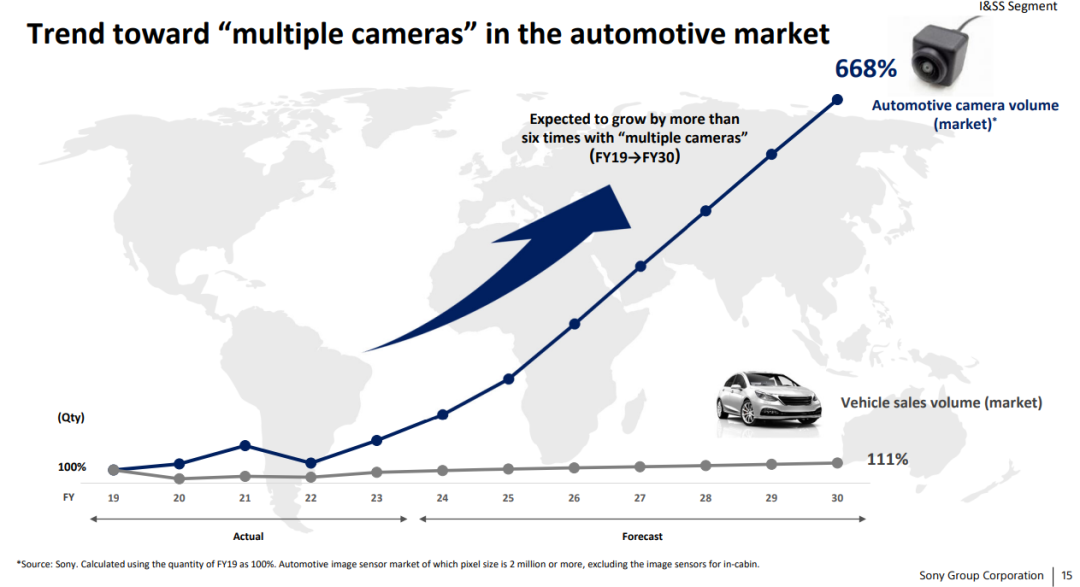
Sony has set its FY2026 automotive CIS market share target at 43% by revenue. By FY2030, global vehicle sales will grow only about 11% compared with FY2019, but the market for automotive image sensors of 2MP and above will expand to about 6.7 times, driven mainly by the trend toward multiple cameras per vehicle. This growth mainly comes from three directions: an increase in the number of cameras per vehicle, smaller pixel sizes, and higher pixel counts.
Source: Sony
Another relatively clear direction is industrial machine vision.
In recent years, Sony has been continuously expanding its global shutter CIS product lineup. Since 2023, it has successively launched industrial global shutter products such as the IMX900, IMX901, IMX925, and IMX927, and stated that as factory automation advances, demand in the industrial equipment market for high-speed, high-resolution machine vision cameras is increasing. Meanwhile, domestic Chinese CIS manufacturers such as SmartSens and OmniVision are also actively covering the related market.
Based on the information currently available, not all Sony CMOS products are experiencing tight supply simultaneously, but supply pressure on some industrial, security, and application-specific models has already begun to emerge.
On the upstream side, there are material shortages, discontinuation plans, and tightening scheduling; on the demand side, there is incremental growth from automotive and industrial machine vision. Combined with the high cost of switching CMOS components and long validation cycles, once supply and demand become mismatched, it is more likely to be amplified in specific models. This round of Sony CMOS market movement is not an across-the-board shortage; going forward, it is more worthwhile to look at it in the context of specific models and applications.


 Whatsapp
 Email
Email Skype
Skype