

It is rumored that NXP plans to acquire Ambarella. What could be the underlying reasons?
01 Ambarella holds strengths in consumer and industrial image processing.
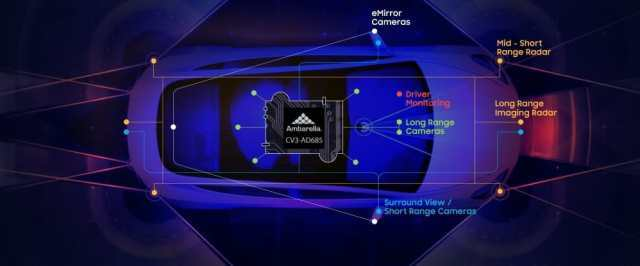
Headquartered in Santa Clara, California, processor designer Ambarella is widely viewed as an automotive semiconductor firm that continuously rolls out solutions for ADAS and autonomous driving. In reality, however, automotive business accounts for only 22% of its revenue, with the rest generated from image applications in consumer and industrial segments.
Founded in 2004 by Feng-Ming Wang and Les Kohn, Ambarella went public in 2012. Its image processing technology is deployed across ADAS, autonomous vehicles, security cameras and robotics. Such AI image processors are poised to complement NXP’s camera-based sensing and recognition solutions for automotive, security and other embedded camera applications.
Ambarella is known for its autonomous driving solutions; Source: Ambarella
Ambarella is renowned for its strengths in image processing. Beyond conventional computer vision, the company has expanded into AI-based technologies. Furthermore, Ambarella extends its highly specialized image processing expertise to edge AI, enabling complex AI models to run directly on devices without relying on the cloud. Originally celebrated for pioneering ADAS semiconductors, it has gradually evolved into a supplier of low-power AI chips and software for edge devices including cameras, vehicles and robots.
For instance, Ambarella signed a procurement and joint development agreement with South Korea’s Hanwha Group in May 2026 valued at over USD 800 million. Under the deal, Ambarella will integrate its existing and next-generation SoCs and software into Hanwha’s product portfolio spanning video surveillance, robotics, industrial automation and life sciences.
02 Supplementing NXP's Edge AI Strategy
NXP is also building its edge AI product portfolio by advancing the acquisition, development and licensing of various AI engines, namely NPUs. In October 2025, NXP acquired Aviva Links and Kinara for USD 243 million and USD 307 million respectively. Both transactions reflect the company’s broader strategic focus on AI hardware and connectivity technologies for embedded systems.
Against this backdrop, the ongoing talks reported by the Financial Times may target not only the automotive sector but also the edge AI segments where Ambarella is expanding its footprint, such as portable video devices and robotics. For example, the acquisition could equip NXP to deliver cross-domain, multi-modal sensor fusion technology — technology widely regarded as highly competitive for product design in the AI era.
03 Still a highly attractive acquisition target despite losses
Ambarella is currently loss-making. Industry insiders reckon the company has slim prospects of achieving profitability over the next three years. In fact, Ambarella has been reviewing strategic options, including a potential company sale, since at least mid-2025. On the flip side, given the growth potential across both automotive and edge AI sectors, the firm stands out as a highly attractive acquisition target.

Application examples of Ambarella solutions; Source: Ambarella
Talks with NXP may not evolve into a formal acquisition proposal, and negotiations could end without the two sides reaching a definitive agreement. Besides, other potential bidders may emerge. Large semiconductor manufacturers are pursuing business consolidation and racing to secure AI-related technologies and assets.
On the other hand, valued at approximately USD 3.3 billion, Ambarella has to keep investing heavily in edge AI technology while competing against rivals including Microchip Technology, Qualcomm and Synaptics. As a result, it is becoming increasingly challenging for Ambarella, a specialist in image processing chips, to secure sufficient capital for continuous AI chip development.
Neither NXP nor Ambarella has commented on the Financial Times report.


 Whatsapp
 Email
Email Skype
Skype