

MLCC Price Surge: The Many Faces of Huaqiangbei
MLCC price hikes: a diverse picture of life in Huaqiangbei.
"Price of Murata’s 1206-476 part number jumps another 5% in a single day", "Oversupply of high-capacity GPU discrete components remains tight even with a 15% markup", and "Prices of high-capacity products swing daily amid mild price volatility" — these are the on-the-ground findings reported by reporters from Sci-Tech Innovation Board Daily during a recent field survey of MLCC markets in Huaqiang North.
A single GB300 server now consumes upwards of 30,000 MLCC units. As major Japanese and South Korean manufacturers proactively slash production capacity for consumer-grade components to pivot toward high-margin AI and automotive-spec products, a structural shortage is sweeping the market, centering on MLCC capacitors and extending to other passive electronic components including resistors, inductors and electromagnetic parts.
Industry chain insiders told reporters from Sci-Tech Innovation Board Daily that while leading domestic manufacturers such as Fenghua Advanced Technology and Sanhuan Group have made breakthroughs in core technical indicators including dielectric layer thickness and stacking layers, and secured access to domestic AI server supply chains, domestic suppliers are still trapped by three major bottlenecks — raw materials, manufacturing processes and product certification — when it comes to high-capacity AI MLCCs used in top-tier supply chains like NVIDIA’s. From price turbulence across Huaqiang North’s distribution channels to incremental improvements in the localization rate of high-end MLCCs, a fierce industrial battle has quietly unfolded.
Distribution Turmoil & Tight Supply of High-End Products amid Structural Shortage
In early July, Huaqiang North had already endured months of price hikes for high-capacity MLCCs. On the first and second floors of Huaqiang Electronics World Building, merchants in the electronic components zone carried out goods receiving and delivery in an orderly manner, chatting about the overall market transactions during breaks. Merchants have seemingly come to terms with the across-the-board price surge of electronic components.
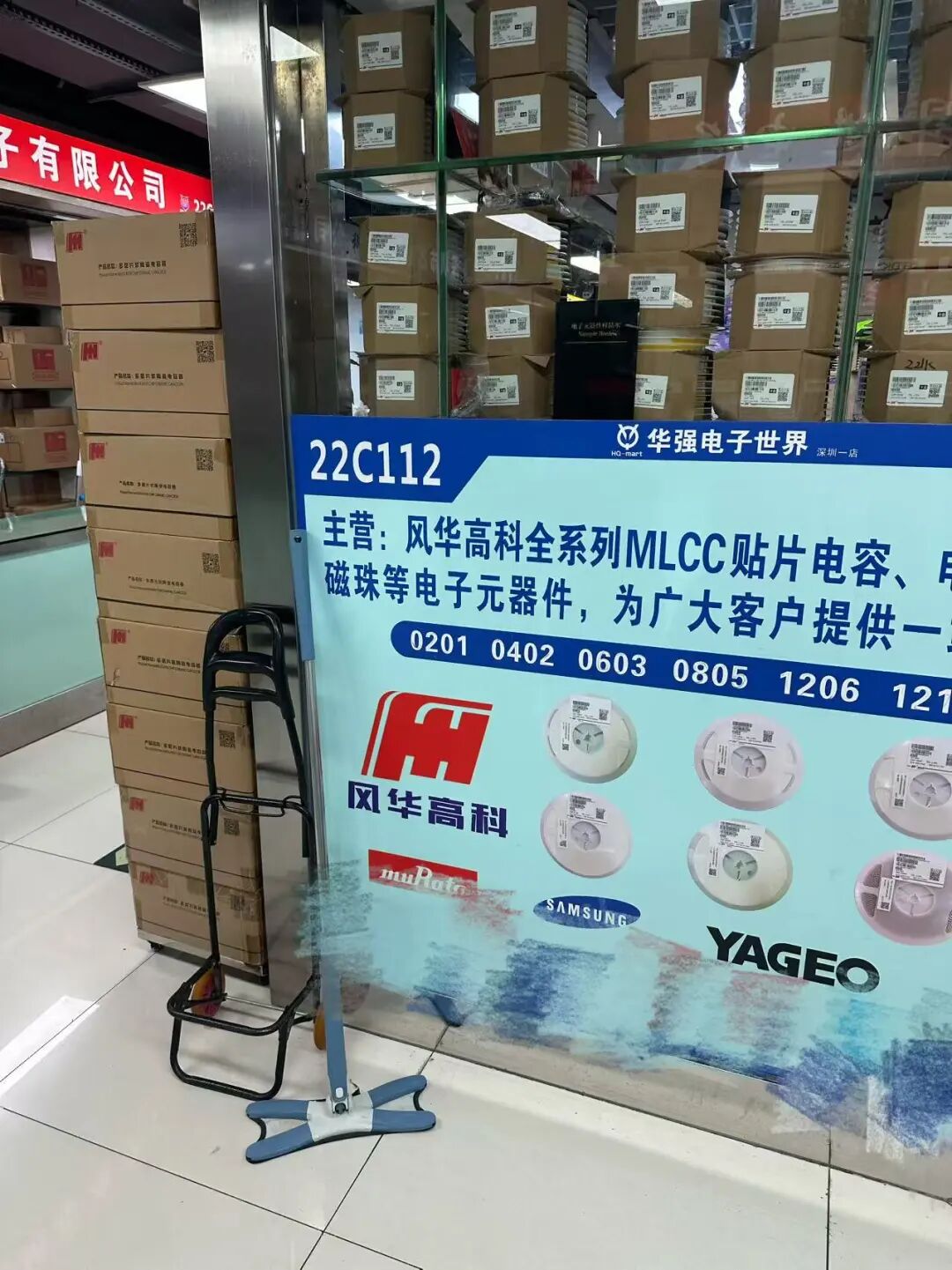
(Photo: First floor of Huaqiang Electronics World; Photographed by reporter of Science and Technology Innovation Board Daily)
Judging from on-site observations, obvious stockpiling behavior was seen among authorized distributors on the first floor of Huaqiang Electronics World.
One merchant distributing products from leading Japanese, South Korean and domestic component brands told reporters with Sci-Tech Innovation Board Daily, “Channel prices of standard MLCC part numbers for server applications keep fluctuating upward. We are able to source original factory goods directly from major manufacturers including Murata and Samsung, yet their prices keep climbing nonstop. Squeezed production capacity has also driven steep price increases for MLCCs of regular specifications.”
High-capacity MLCCs for AI servers kept rising in price across Huaqiang North on the morning of July 4. The mainstream Murata 1206 47μF high-capacity model was quoted at roughly RMB 650 per 2,000 pieces; the quotation jumped to RMB 670–690 per 2,000 pieces that same afternoon.
On July 5, the component was priced at RMB 700–720 per 2,000 pieces in the morning, before closing higher at RMB 725–755 per 2,000 pieces by the end of business hours.
By the evening of July 6, quotations for this identical mainstream part hit RMB 780–820 per 2,000 pieces.
Throughout July 7, its price further went up to RMB 800–845 per 2,000 pieces.
As of July 9, several vendors raised their quotations once more, with the average price settling between RMB 850 and 890 per 2,000 pieces.
Reporters from Sci-Tech Innovation Board Daily learned from field visits that the price rally is not limited solely to high-capacity MLCCs. Ordinary capacitors apart from MLCCs, along with resistors, electromagnetic components, inductors and other passive electronic components have all been swept up in price hikes.
A staff member at the aforementioned authorized distributor stated: “Japanese and Korean manufacturers have raised prices for various passive components such as electromagnetic parts and resistors since late last year and early this year, with an overall price increase of 10% to 15%. Prices stabilized after these rounds of adjustments. In contrast, end-market prices of high-capacity MLCCs keep climbing continuously, and several original equipment manufacturers have also rolled out price increases for high-capacity MLCCs starting in July.”
A general electronic component vendor on the second floor of Huaqiang Electronics World told our reporter: “Capacitors have seen drastic price surges, with quotations updated on a daily basis, and in some cases revised multiple times within a single day. The price of one reel of capacitors can swing by dozens of RMB in one trading day.”
“Such drastic volatility is quite notable. Prices of mainstream part numbers have practically doubled. Buyers have begun to hold off on purchases amid steep cost inflation. Currently, market price surges are largely driven by stockpiling activities. Apart from Yageo, we have not received additional price adjustment notices from other leading component manufacturers. Prices for standard part numbers do not rise every day; they fluctuate moderately subject to actual market demand and inventory levels,” the vendor added.
Some merchants operating in Huaqiang North hold a different view: “These passive components ramp up production volume far faster than memory chips. They deliver strong short-term price momentum, yet their upward price cycle will not last as long as that of memory products. Previously, this sector suffered from slim profit margins and slow volume growth. The current steep price surge will accelerate production output sooner or later, which will eventually pull market prices back down.”
Merchants Face Mixed Fortunes as Undercurrents Stir the Market
After enduring prolonged price hikes for electronic components, merchants in Huaqiang North have built up certain psychological expectations for further price increases. During the field interview conducted by reporters from STAR Market Daily, many vendors let out helpless smiles when talking about price surges and commented that “we are flooded with inquiries every day recently”.
Some shop owners waved their hands and responded bluntly: “Don’t even ask—we have no stock available.” “We have no choice but to accept the current market reality. Massive price surges do not translate to easier business operations. We either fail to source goods from manufacturers or cannot fulfill customer orders; meanwhile, clients complain about the exorbitant pricing.”
Other distributors mentioned, “We only run small-scale trading businesses.” Although high-capacity part numbers sell fast at high margins, sourcing inventory has become extremely tough. Widespread stock shortages from original manufacturers have triggered fierce competition for goods across the market. We have to keep close track of manufacturers’ sales updates daily; any slight delay will result in the sought-after components being snatched up by other traders, making this line of work highly taxing.
They added: “Sales performance of consumer-grade components used in smartphones and laptops remains sluggish. These products have also edged up in price, yet the markup is quite moderate. The core issue lies in the sharp price inflation of end products such as mobile phones and computers, and word has it that sales volumes of these consumer devices have slumped badly recently.”
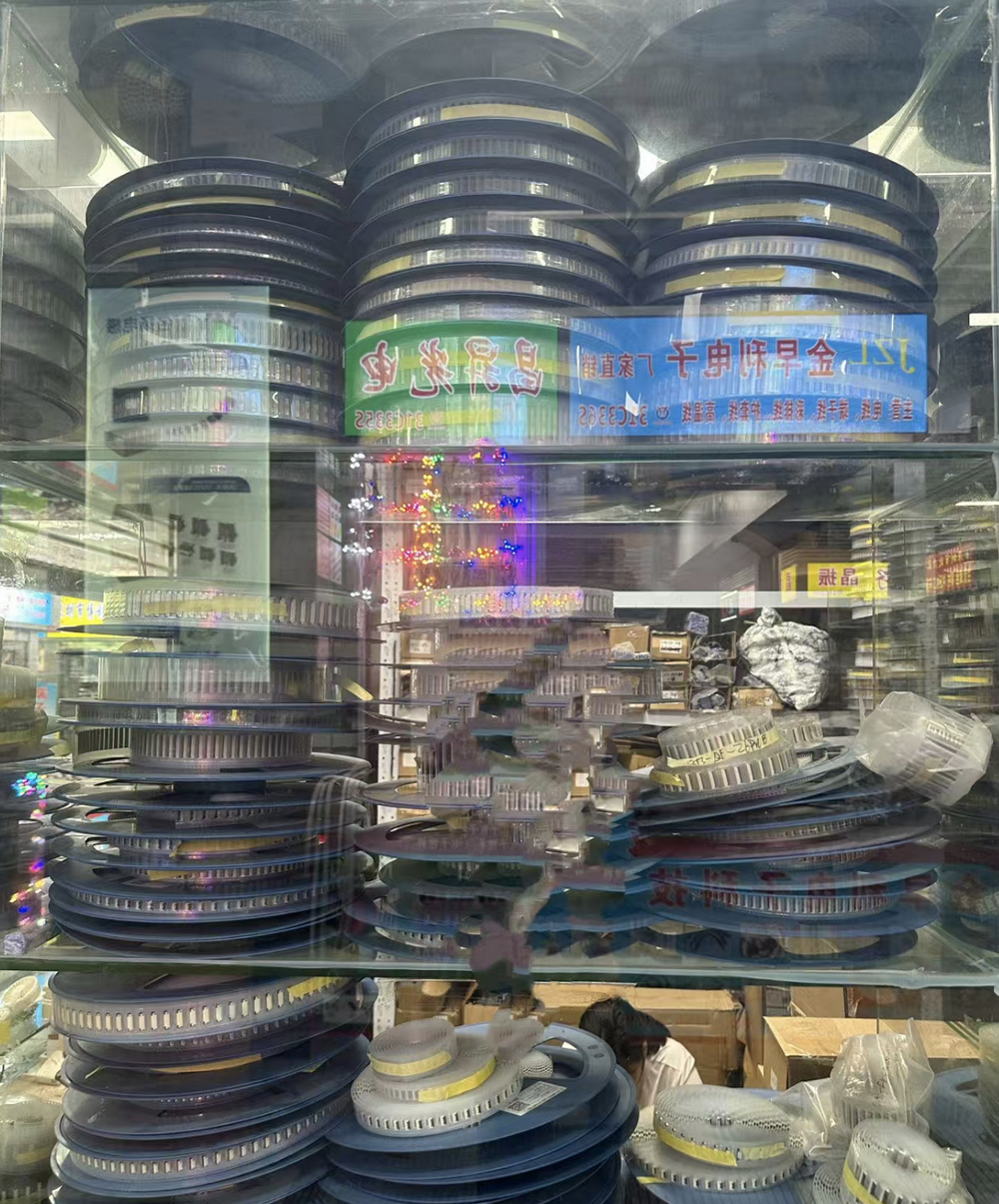
(Photo: Second floor of Huaqiang Electronics World, taken by a reporter from the Science and Technology Innovation Board Daily)
In addition, a sales representative from a large electronic component distributor in Shenzhen told reporters from the STAR Market Daily: "Because capacitor and resistor prices have risen sharply this year, a lot of counterfeit goods have appeared on the market. Earlier, a client brought us a circuit board and reported various issues. We used X-ray to inspect the internal lead pins and found many voids and cold solder joints. It turned out that refurbished parts had been mixed into the batch, and in the end, the entire shipment had to be recalled."
Separately, a salesperson from a smaller distributor also told the STAR Market Daily: "Some factory clients have taken the opposite approach—they say they don't make money making products, but they can make money selling capacitors instead. So they've stopped their production lines and asked us to help sell off all their accumulated capacitor inventory and spot goods."
The impact of AI and automotive-grade high-capacity "crowding-out effect"
According to field research and insights from industry chain sources, the STAR Market Daily learned that the recent price hikes are not a broad-based increase across all product categories, but rather a typical case of "structural tightness." That is, AI servers and automotive‑grade high‑capacitance MLCCs are facing severe shortages with sharp price surges, while supply and demand for general‑purpose consumer‑grade components remain relatively balanced, with only modest price increases.
This means that not all domestic manufacturers will benefit equally. Only those with proven mass‑production capabilities in high‑capacitance, automotive‑grade MLCCs can enjoy both volume and price growth during this upcycle. In contrast, companies that remain focused on low‑to‑mid‑tier consumer‑grade products will continue to face a situation where "prices are rising, but sales volumes are only so‑so."
According to research reports from several brokerages including CITIC Securities and Guosen Securities, the current MLCC price rally is driven by a “triple resonance” across demand, supply, and costs.
On the demand side, AI servers have become a “material devourer”—a single GB300 server uses as many as 30,000 MLCC units. Coupled with the continued ramp‑up of new products like NVIDIA’s VR200, global AI server orders have surged, directly fueling strong demand for high‑end resistors and capacitors.
On the supply side, Japanese and Korean manufacturers have proactively cut production capacity, leading to a cliff‑like drop in general‑purpose component supply. Major players such as Murata and Samsung have deliberately reduced output of consumer‑grade general‑purpose capacitors and are shifting capacity toward AI‑oriented and automotive‑grade high‑margin products. With capacity expansion cycles lasting 18 to 24 months, the near‑term supply‑demand gap is unlikely to be filled anytime soon.
On the cost front, rising raw material prices have pushed up the cost floor. Prices of silver, copper, tin, and other raw materials continue to climb—silver, a key material for resistors, has seen its price rise, directly elevating production costs. As a result, original manufacturers have raised their prices, and distributors have followed suit with further markups.
However, benefiting from the recent price hikes at the end‑user level, major original manufacturers and their distributor‑agents that are publicly listed have also drawn significant attention from the capital markets.
During a recent investor briefing, Shenzhen Huaqiang stated that the company is a major authorized distributor of Murata globally. It has recently observed an increase in customer orders, with clients starting to pick up goods and proactively replenish inventories. For certain models that are in short supply, the company prioritizes fulfilling the procurement needs of large customers. A representative from its securities department told the STAR Market Daily that among all product shipments, memory‑related products are showing relatively optimistic shipment performance, thanks to the solid logic of computing‑power‑driven price increases. However, “the shipment situation for consumer‑grade MLCCs is not as optimistic.”
Regarding the pricing agreement mechanism with original manufacturers, Sunlord Electronics (Shangluo Electronics) mentioned during a recent investor briefing that the company operates on a quarterly price‑negotiation model. Under this pricing framework, even if upstream component prices fluctuate sharply, it does not cause a corresponding sharp expansion or contraction in the company’s profit margins. If the market experiences significant volatility within a single quarter, the company can adjust both upstream procurement prices and downstream selling prices in accordance with price revisions approved by the original manufacturers.
Core Indicators Surpassed by Some Industry Leaders
From the perspective of the global competitive landscape, the MLCC industry features a highly concentrated oligopolistic structure. According to research data from Guosen Securities, the world’s top five MLCC manufacturers (Murata, Samsung Electro-Mechanics, Taiyo Yuden, TDK and Kyocera) collectively captured a 77.3% share of the global MLCC market in 2024, with Murata alone accounting for 31.8%.
In the high-capacitance MLCC segment, Murata holds approximately 50%–55% market share, South Korea’s Samsung Electro-Mechanics accounts for 25%–28%, while domestic Chinese manufacturers take less than 2% of the market. High-grade MLCC part numbers demanded by AI servers are currently dominated mainly by Murata, Samsung Electro-Mechanics and Taiyo Yuden; certain ultra-high-end specifications are virtually monopolized solely by Murata and Samsung Electro-Mechanics.
Meanwhile, breakthroughs in domestic localization are being achieved continuously.
Leading MLCC manufacturer Sanhuan Group was listed on the Hong Kong Stock Exchange on July 9 this year. As stated in its prospectus, the company has developed high-end MLCCs with a dielectric layer thickness of roughly 1 micron and over 1,000 stacked layers, laying a solid foundation for its entry into high-end application scenarios including AI data centers and automotive electronics.
Regarding this top-tier technical milestone it has accomplished, a staff member from Sanhuan Group’s Securities Department commented: “This ultra-high technical specification has already been adopted in our products, yet we are unable to disclose details about the specific product lines and production volume.”
The Hong Kong IPO prospectus also disclosed that the Group’s MLCC products have obtained AEC-Q200 automotive-grade certification. Its automotive-grade MLCC series are gradually being deployed in power supplies, motor drive systems and infotainment systems for new energy vehicles. For AI and data center applications, its MLCC components have passed qualification audits by major domestic AI server clients such as Huawei and Inspur Information, and the company is vigorously expanding its footprint in the relevant high-end market.
Another premium MLCC leader, Micro-Rong Technology, had its IPO application accepted by the Shenzhen Stock Exchange back in April this year. According to the firm’s prospectus, Micro-Rong Technology is one of the very few manufacturers capable of mass production and bulk delivery of ultra-miniature MLCCs in chip sizes 008004, 01005 and 0201.
In industrial equipment centered on AI servers, Micro-Rong’s MLCCs boast outstanding high-capacitance performance. The enterprise has mastered a lamination process exceeding 1,200 layers (note: stacking above 1,000 layers is deemed an extremely challenging technical benchmark). Powered by this core technological breakthrough, its industrial-grade MLCCs deliver ultra-high capacitances of 100μF (0805 package) and 220μF (1206 package) respectively. These components are now supplied in volume to leading server makers, pioneering the elimination of the supply gap previously unfilled by mainland Chinese manufacturers.
In the automotive-grade sector, Micro-Rong Technology is the first manufacturer in Chinese mainland to develop and sustain mass supply of high-capacitance automotive MLCCs rated 100μF and 220μF in the 1210 package size.
Fenghua Advanced Technology recently announced via its official WeChat official account and other platforms that the company has independently developed and manufactured eight categories of key raw materials, including high-purity ultrafine barium titanate ceramic powder and nickel electrode slurry. It has also collaborated with domestic equipment manufacturers to realize the localization of more than ten core production devices. Its newly released core technical breakthrough lies in the reduction of dielectric layer thickness for capacitors from the original 2μm down to 0.6μm.
Reporters from Sci-Tech Innovation Board Daily made repeated calls to the company to inquire about the maximum stacking layers Fenghua Advanced Technology has achieved, as well as whether the 0.6μm dielectric layer thickness has been put into mass production, yet no staff answered the calls.
When commenting on the latest core technical parameters and progress of domestic high-end MLCC products, a securities analyst specializing in the electronic materials industry stated that Murata and Taiyo Yuden currently offer the highest capacitance specification of 220μF in the 1206 package size. Sanhuan Group and Fenghua Advanced Technology have achieved mass production of 100μF MLCCs in the same 1206 size; Fenghua’s 220μF variant is undergoing small-batch verification and sample delivery. By contrast, Micro-Rong Technology has realized mass production of 220μF MLCCs in the 1206 package and delivers these products in bulk to leading domestic AI server manufacturers.
In terms of core technical indicators comparison, Japanese and South Korean manufacturers have achieved mass production of dielectric layers ranging from 0.35 μm to 0.5 μm for MLCCs deployed in AI servers, with ongoing R&D targeting thicknesses below 0.4 μm. Their maximum dielectric stacking layers can reach 1,600 layers, while their mainstream technical capability falls between 1,000 and 1,600 layers.
The latest updates from domestic Chinese manufacturers show that Fenghua Advanced Technology has broken through the 0.6 μm threshold for dielectric layer thickness, and Micro-Rong Technology has attained a maximum stacking layer count of 1,200 layers. Overall, domestic players generally deliver dielectric thicknesses of 0.6–1.0 μm with stacking layers ranging from 800 to 1,000.
Turning to upstream powder materials, Sinocera Materials is the only domestic Chinese enterprise and the world’s second firm overall (after Japan’s Sakai Chemical) that masters the hydrothermal method for mass production of nano-scale high-purity barium titanate powder. It can mass-produce high-end powder with particle sizes of 50–100 nm. This core material directly underpins the high-capacitance and high-frequency performance of MLCCs, ending the long-standing monopoly held by Japanese enterprises in this field.
According to public disclosures by Sinocera Materials, its current annual production capacity for standard MLCC powder stands at approximately 10,000 tons. The company plans to add another 5,000 tons of annual capacity dedicated to high-end production lines for AI servers and automotive-grade applications. Among this expansion, 2,000 tons of new capacity was commissioned at the end of 2025 and has passed qualification verification by key leading customers. The remaining 3,000 tons are scheduled to come online by the end of 2026, which will lift the company’s total annual capacity to 15,000 tons. It is projected that the company’s high-end powder sales will exceed 1,000 tons in 2026, with bulk shipments commencing in the third quarter of the same year.
When asked about the latest progress of the aforementioned high-end capacity layout, a representative from the Securities Department of Sinocera Materials told reporters from Sci-Tech Innovation Board Daily: “The 2,000-ton capacity was put into production at the end of 2025. The launch timeline for the remaining 3,000 tons will be determined based on customer demand uptake for the existing 2,000-ton capacity; construction and commissioning for the 3,000-ton segment have not yet commenced.”
Sinocera Materials has also stated on numerous public occasions that it supplies barium titanate powder to Fenghua Advanced Technology and Sanhuan Group. Judging from the capacity expansion plans and production ramp-up schedules announced by these three enterprises, they have formed upstream and downstream synergy in the overall MLCC capacity expansion chain.
Continuous Evolution of MLCC Technological Iteration
According to data from Frost & Sullivan, China’s domestic localization rate of the MLCC market rose from 14.1% to 16.0% between 2020 and 2024. Looking ahead, there remains ample room for localization in China’s MLCC market. Domestic manufacturers are poised to deliver robust growth, with the localization rate projected to climb to 24.0% by 2029.
Industry insiders along the electronic component industrial chain commented that the memory chip sector once faced identical market challenges: core upstream materials monopolized by a handful of countries, highly concentrated market share, and extremely rapid technological iteration. Nevertheless, the path for domestic breakthrough differs greatly between memory chips and high-end MLCCs. The memory industry underwent a pivotal technological shift from 2D to 3D architecture, which granted domestic enterprises an opportunity to achieve overtaking via alternative technological routes.
Analysts noted that MLCC technology evolves in an incremental, continuous manner, marked solely by thinner dielectric layers and increased stacking layers. As such, domestic manufacturers have no choice but to catch up directly alongside leading Japanese and American peers on the same technological track. The core gaps separating domestic players from Japanese and US industry leaders lie in three key areas: high-end raw materials, ultra-thin film processing technology, and lengthy qualification certification cycles.
That said, “MLCC serves as a highly customized auxiliary electronic component. Particularly for automotive-grade and AI server applications, each customer has vastly divergent requirements for combinations of capacitance, voltage resistance and component dimensions, resulting in extremely high switching costs for product replacement.”
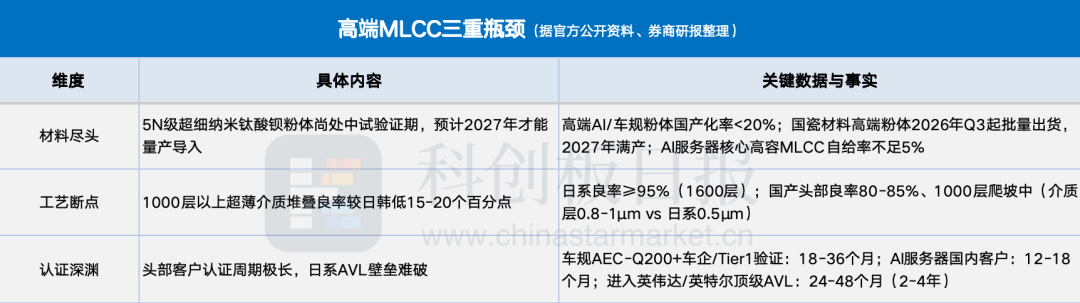
This also indicates that the substitution of high-capacitance MLCCs produced by domestic manufacturers will follow a gradual path, with breakthroughs achieved step by step across four phases: consumer electronics, domestic automotive electronics, domestic AI servers, and finally the global supply chain.
After accomplishing comprehensive substitution within the consumer electronics sector in the short term, the toughest challenge ahead will be breaking down the certification barriers for international automotive-grade standards and top-tier AI server applications.


 Whatsapp
 Email
Email Skype
Skype