

“ST MCU chips have a different price every single day.”
01 What’s going on with ST chips right now?
Overall, the current wave of ST's popularity began to show signs in mid-to-late June, and by early July it had fully "erupted." Even now, the enthusiasm in the spot market for ST chips remains unabated, with both prices and demand still running high.
At present, the hot models in the spot market are mainly concentrated in the STM32 series of MCUs.
According to third‑party website popularity data, in the first half of June, regulars on the trending lists such as STM32F103C8T6 and STM32F405RGT6 were still near the top, but without any noticeable rise in popularity; on the contrary, they saw a week‑over‑week decline in interest.
The turning point came in the week of June 22, when those commonly seen ST parts on the trending list began to see week‑over‑week growth. Since then, their popularity has risen for three consecutive weeks, hitting a new peak in the week of July 6.
Moreover, the number of popular ST parts appearing on the trending list has also increased. For most of June, the ST models on the trending list were concentrated in two families: the F1 series (STM32F103C8T6, STM32F103RCT6) and the F4 series (STM32F405RGT6, STM32F407VET6).
In the final week of June, the F4‑series STM32F407VGT6 also made it onto the list. By the week of July 6, the H7 series and the STM8 series had entered the top 10 trending rankings. Zooming out a bit, among the top 50 trending parts, ST's G0, L4, and F7 series, as well as MEMS sensors, were also included.
Looking at specific models, here are some of the currently hotter ST parts in the market:
STM32F405RGT6 – part of ST's F4 foundational product line, positioned between entry‑level and advanced lines. According to some distributors, this part can also be used in drones.
Moreover, the number of popular ST parts appearing on the trending list has also increased. For most of June, the ST models on the trending list were concentrated in two families: the F1 series (STM32F103C8T6, STM32F103RCT6) and the F4 series (STM32F405RGT6, STM32F407VET6).
In the final week of June, the F4‑series STM32F407VGT6 also made it onto the list. By the week of July 6, the H7 series and the STM8 series had entered the top 10 trending rankings. Zooming out a bit, among the top 50 trending parts, ST's G0, L4, and F7 series, as well as MEMS sensors, were also included.
Looking at specific models, here are some of the currently hotter ST parts in the market:
STM32F405RGT6 – part of ST's F4 foundational product line, positioned between entry‑level and advanced lines. According to some distributors, this part can also be used in drones.
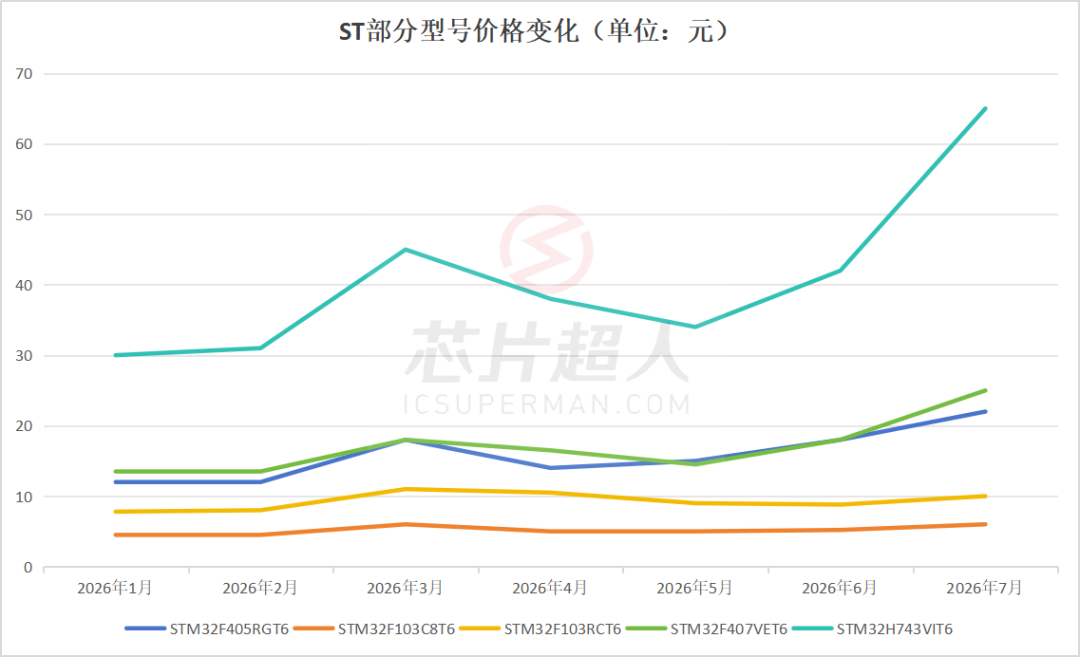
It is worth noting that market quotes remain quite chaotic at present. In fact, over the past few days, some distributors believe that prices of these popular ST MCUs are still rising, while others feel that prices for certain models have begun to ease back a bit.
As for the current situation in the spot market, sentiments appear rather "divided." Some say that these ST parts have indeed become somewhat scarce recently, while others think that there is actually no shortage of supply out there.
In terms of actual end‑user demand, some distributors indicate that the bulk of trading is still happening among traders themselves.
However, there is one thing everyone agrees on: the quotes are a mess. "It's unstable – the quoted prices are all over the place," and "prices change every day – it only creates abnormal orders for us."
02 Why the Surge Again? What's Happening?
To understand this round of price increases, it's necessary to first briefly review how ST's prices have behaved over the past few years.
In the second half of 2022, ST prices took a nosedive and kept falling. By the end of 2024, many popular models had reached two‑year lows, with prices persistently inverted – meaning distributors were routinely selling at a loss.
At the beginning of 2025, ST's general‑purpose MCU prices finally bottomed out and started to recover. The prices of popular ST general‑purpose MCUs gradually returned to normal levels from their earlier inverted state, and the industry widely saw this as a rational correction. Later, tariff‑related turbulence briefly drove prices up, but they soon fell back again.
In December 2025, there were whispers in the chip distribution market about price hikes, though at the time they were only modest increases with no significant magnitude.
In March 2026, affected by extended lead times from ST and rising quotes for certain models, chips such as the STM32F405RGT6 saw their prices spike quickly. However, within half a month, prices softened and then collapsed.
This round of ST's hot market conditions began in mid‑to‑late June. Most chip distributors believe that this rally is the result of a combination of factors: extended ST lead times, price‑increase notices, market rumors, and overall market sentiment.
On May 28, ST issued its second price‑hike notice of the year, announcing that prices would be raised on certain products effective June 28. The notice cited continued increases in operating costs such as raw materials, transportation, and labor, and noted that product lines not previously covered would also be included in the adjustment.
After the notice was issued, the market reaction was relatively muted. Instead, it was the subsequent leak of a lead‑time extension table that really fueled market heat. Around June 20, a friend who primarily deals in ST chips mentioned that a table showing extended lead times was circulating within the industry. Around June 26, another table with lead‑time extensions broken down by process node surfaced: 90nm (F2/F4/F7, G0/G4/L4, etc.) was extended from 30 weeks to 52 weeks, while 180nm (F0/F1/F3) and 130nm (STM8) went from 30 weeks to 40 weeks.
In early July, a screenshot began making the rounds, allegedly showing that ST had "strictly prohibited the sale of any STM materials to non‑end customers with trading/distribution characteristics." The authenticity of the screenshot could not be verified, but the successive flow of information about extended lead times and tightening channel access kept pushing the market in a hotter direction.
Since last week, purchase requests have been flooding almost every chip‑related chat group, with some models seeing prices change by the day. The price‑hike notice, extended lead times, and rumors of channel controls have all converged, pushing prices to a fever pitch.
Beyond these common factors, there are also some model‑specific reasons behind this round of price increases. Take the STM32F405RGT6 as an example. After the price‑hike notice was issued, the market reaction was relatively muted – it was the subsequent leak of the lead‑time extension table that really fueled the heat. According to some industry distributors, the extended lead times triggered a chain reaction: large end‑customers, fearing supply shortages, bought up stock at low prices, and by June there were already signs of "tight supply." This stockpiling behavior was also confirmed by several chip distributors.
At the same time, some suppliers said that due to original manufacturer controls and other factors, many were reluctant to release inventory. However, some traders in the market pointed out that there was actually no shortage of spot supply for this particular part.
Market quotes remain quite chaotic. Many chip procurement professionals have said that because prices are changing so frequently, they sometimes have no choice but to cancel orders. As for ST's future direction, some believe prices will continue to rise, while others think it is merely "sentiment‑driven trading." Most market participants are currently in a wait‑and‑see mode.
Looking at ST's own financial reports, the company posted net revenue of $3.095 billion in the first quarter of this year, up 23% year‑over‑year and exceeding market expectations. Among its business segments, the Embedded Processing (EMP) segment showed significant growth, and the report explicitly attributed this to general‑purpose MCUs.
On the inventory front, ending inventory stood at $3.173 billion, up slightly by about 1% from the previous quarter's $3.136 billion – essentially flat. CEO Jean‑Marc Chery commented: "Despite macro uncertainties, we see improving demand, strong orders, and distribution channel inventories have normalized." He also noted that the book‑to‑bill ratio was well above 1 across all end‑markets and regions, that Q2 revenue expectations were significantly above the seasonal average, and that the company expects double‑digit revenue growth for the full year 2026.


 Whatsapp
 Email
Email Skype
Skype