

Price hikes and suspended quotations—what‘s the current situation with passive components?
01 Price increases, price suspensions?
What's the situation in the passive component market?
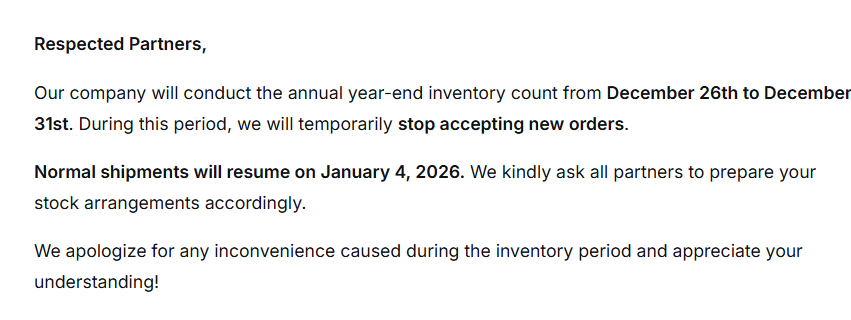
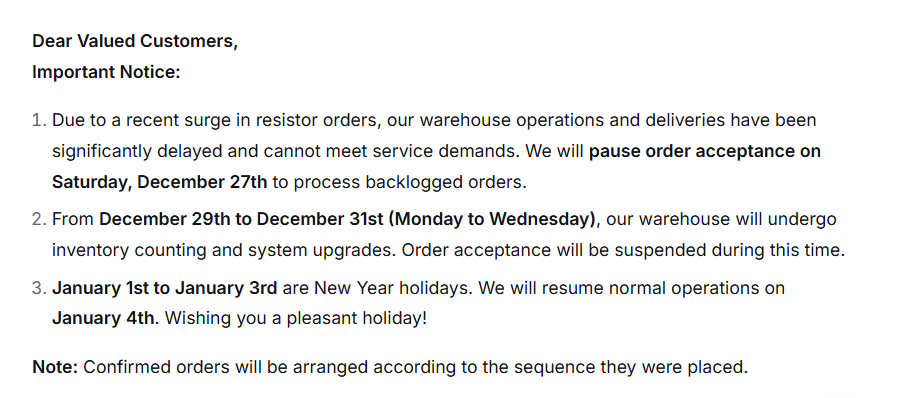
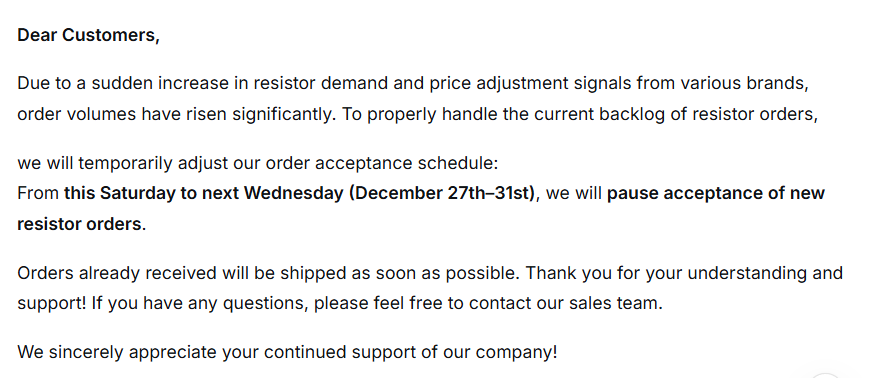
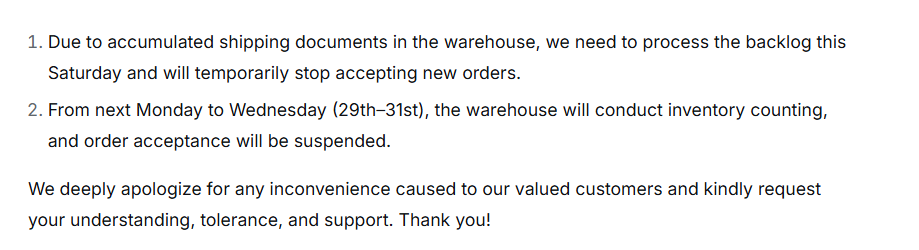
Initially, after inquiries, it was confirmed that there was indeed a suspension of price quotations for passive components before New Year's Day.
Source: Internet
Some distributors noted that the primary reason for suspending price quotations at the time was that the specific price increases from manufacturers had not yet been finalized. Quotations issued before the holiday might become invalid afterward, so they only provided prices for orders that could be shipped on the same day, while deferring all other cases.
Other distributors mentioned that before New Year's Day, several leading chip resistor agents collectively notified of inventory checks, which drove up market prices for certain types of resistors.
After New Year's Day, most channels have resumed normal quotations. However, for some high-demand models, a few spot suppliers are still holding back on sales, and normal supply has not yet been fully restored.
Additionally, some chip distributors indicated that in recent days, certain passive distributors have continued to suspend order acceptance, though this is not a widespread industry trend. Some agents mentioned that manufacturers' delivery timelines and information remain unclear, leading them to temporarily halt shipments to ensure supply for key end customers and important clients.
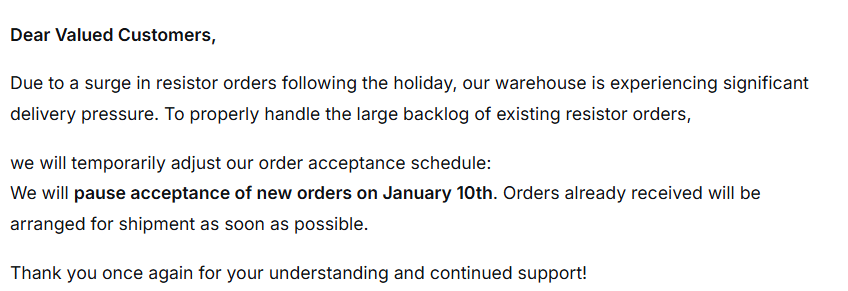
Looking at specific segments, most resistor prices have already increased, though the exact magnitude of the increase varies depending on the situation. Some say the increase is similar to the rate mentioned in the manufacturers' official price hike notices, while others note that increases range from a dozen percentage points to thirty or more, depending on the model, with even higher increases for certain niche or in-demand models. Some even bluntly state that current pricing is "too chaotic," with prices varying widely.
In comparison, price hikes for common, standard capacitor models are not as exaggerated, though they have still risen. However, certain in-demand models, such as polymer tantalum capacitors and high-capacitance, high-voltage ceramic capacitors, have seen significant increases. Distributors note that these in-demand items are still being quoted normally, but the quotes are generally valid only for the day or the following day. Moreover, these capacitors had already begun to rise in price before New Year's Day.
Additionally, distributors mention that magnetic beads and inductors have also seen substantial increases—some even more dramatic.
Overall, demand for resistors and capacitors remained relatively stable throughout 2025, but profit margins were severely compressed. It was only towards the end of the year that demand saw a noticeable surge. Among these, panic stockpiling was more pronounced for resistors, though this was only partial, as many end-users found it "difficult to adjust prices quickly."
Currently, it is less common for agents to raise prices, especially for models with existing inventory. Multiple agents have indicated that they will maintain original prices for end customers within a certain timeframe and quantity. However, for models without inventory, prices are adjusted according to market conditions. Some agents have expressed that while manufacturers increase prices, end customers do not, leaving them feeling like the "first wave to bear the brunt." In contrast, traders’ responses have been more dynamic.
Overall, there are several reasons behind the more pronounced price increases for resistors. First, among the manufacturers issuing price hike notices this round, resistor manufacturers are relatively more numerous, while capacitor price increases are primarily concentrated in companies like Fenghua Advanced Technology and certain Taiwanese, Japanese, and Korean manufacturers in categories such as tantalum capacitors. Second, the rising cost of precious metal raw materials, especially silver, mentioned in the price hike notices, significantly impacts the production costs of resistors and inductors. Additionally, domestic brands of resistors have relatively lower prices, making them more susceptible to cost fluctuations. Furthermore, some distributors have suggested that this may also be related to the relatively lower inventory levels of resistors held by companies.
02 Passive component price surge is coming
This round of price hikes for passive components is not an overnight occurrence in terms of the timeline, but a gradual spread that has expanded from specific products to the entire sector.
A brief summary of this price surge for passive components: In April last year, Panasonic and KEMET (a subsidiary of Yageo) issued price increase notices, announcing hikes for tantalum capacitors and kicking off a wave of successive price rises for this product category. This was followed by price adjustments from Neo-Yun in May, Kyocera in June, a second hike by Kyocera in September, and a second price increase by KEMET in October.
Starting in November, the price hikes began to spread to other categories such as resistors, inductors and magnetic beads. Tai-Tsing Technology raised the prices of magnetic beads and inductors due to the surge in silver prices. At the end of November, Fenghua Advanced Technology disclosed price adjustments for products including inductor beads, varistors, ceramic capacitors and thick-film circuits.
Entering the early days of 2026, Yageo announced another price hike – its magnetic component brand PULSE released a price adjustment for some of its magnetic beads, inductors and resistors.
January 16, 2026 - According to Taiwan media reports, Yageo has recently sent another price increase notice to its customers, announcing that it will adjust the prices of some resistor products starting from February 1, 2026, with a price hike of approximately 15-20%. The affected products include RC0402, RC0603, RC0805, RC1206 and other resistor series.
Overall, the current scope of this price surge mainly covers the following categories: tantalum capacitors from major overseas and Taiwanese manufacturers, as well as resistors and inductors from numerous Taiwanese brands and domestic Chinese brands such as Fenghua Advanced Technology.
In the spot market, resistors are now seeing the most pronounced price increases, led by domestic Chinese brands. Initially, Taiwanese and overseas original manufacturers had not issued formal price increase notices, yet market prices for their resistors followed the upward trend, resulting in an across-the-board price hike of resistors in the market. In recent days, original Taiwanese resistor manufacturers have also started releasing price increase notices, which may further fuel the upward price momentum in the market.
In general, there are two main reasons behind this collective release of price increase notices by passive component manufacturers:
First, cost pressures stemming from rising prices of raw materials, such as silver and other metal materials including tin, copper, bismuth and cobalt.
Second, the explosive growth in demand driven by AI applications, which has boosted the prices of related products such as tantalum capacitors and high-end MLCCs.
As a critical raw material for the production of passive components, the sharp rise in silver prices in 2025 may have been the direct trigger for this round of price increases, with NYMEX silver futures surging by 143% for the year.
According to reports from Qimo, silver paste accounts for over 50% of the material cost in multilayer inductors and magnetic beads. After supporting costs for a year, major manufacturers have nearly depleted their low-price inventory, pushing inductors into a price hike trend. Passive component manufacturers have stated that silver paste is widely used in the production processes of passive components, but its cost proportion in MLCCs is lower than in inductors, making the impact of rising silver prices more significant for inductors. For example, in the widely used multilayer inductors, silver paste constitutes as much as 45% to 55% of the material cost.
In addition to silver, the across-the-board price increases of major non-ferrous metals such as copper, aluminum, tin, and manganese have further intensified cost pressures.
Some chip distributors have noted that currently, more domestic brand manufacturers are issuing price hike notices for resistors and inductors. This is because, following the significant price increases in previous years, the production capacity of domestic brands for passive components has expanded in recent years, gradually entering the consumer electronics market. However, this has also led to intensified price competition in the sector.
He cited an example: for a 120R 5% resistor, Yageo's price is still over 7 RMB, while some domestic brands have already managed to bring it down to around 3 RMB. This suggests that the profit margins for domestic brand products may be relatively low, making them more susceptible to the impact of cost increases.
Furthermore, the rapid growth in high-end demand, led by AI, is also a significant driver behind this round of passive component price hikes, primarily affecting high-end capacitor products such as tantalum capacitors and high-end MLCCs.
Murata, a global leader in passive components, pointed out that a single NVIDIA GB300 server requires approximately 30,000 MLCCs, while a single server rack may need as many as 440,000 units. It is estimated that by 2030, the demand for MLCCs in AI servers will increase by about 3.3 times compared to 2025. In addition to AI, Samsung Electro-Mechanics, another major passive component manufacturer, has indicated significant growth potential in the high-voltage automotive MLCC market.
According to reports from Taiwanese media, AI and automotive electrification are challenging the physical limits of power and speed, creating dual demands: each device requires more passive components, and these components need to have higher specifications and greater resilience in harsh environments. This has driven increased demand for tantalum capacitors and certain high-end MLCCs, ultimately contributing to the price increases.
According to a TrendForce report from October of last year, the current MLCC market shows a clear polarization. Leading Japanese and Korean manufacturers such as Murata, Taiyo Yuden, and Samsung Electro-Mechanics have benefited from the momentum of AI servers and the launch of new Apple products, resulting in a continuous influx of urgent orders for high-capacity MLCCs in the fourth quarter of 2025.
In contrast, MLCC suppliers from Taiwan, China, and Mainland China have been impacted by sluggish demand for smartphones and laptops, leading to a more conservative procurement approach and a decline in their B/B ratio (book-to-bill ratio). Overall, the MLCC market in the fourth quarter of 2025 was primarily supported by demand from AI infrastructure, while consumer electronics demand remained weak.
TrendForce expects OEMs and ODMs to maintain a cautious procurement strategy. Only high-end MLCC products are likely to sustain relatively stable revenue growth, while orders for standard consumer-grade MLCCs are unlikely to see a significant recovery. This structural divide between "strong high-end demand and weak standard demand" is also reflected in the current feedback from the capacitor spot market.
03 To Conclude
Driven by rising precious metal raw material costs and AI-related demand, the demand and price dynamics of passive components are entering a new phase of adjustment. Fluctuations in the spot market persist, with particularly notable changes observed in categories such as resistors and inductors. However, actual shifts in demand and responses from end-users still require ongoing observation.


 Whatsapp
 Email
Email Skype
Skype