

Hard Drive Prices Unexpectedly Rise in 2026
01 Premeditated Price Hikes
This price hike for HDDs came as a surprise to many, but it had actually been in the making for a long time. More precisely, it was driven by the demand for "cold data storage" spurred by the AI infrastructure boom.
Data is the core production material for AI. Based on the frequency of access and performance requirements, data can be categorized into two types: "hot data" and "cold data". Hot data refers to information that requires frequent queries and retrievals, while cold data, on the contrary, is accessed almost not at all but in extremely large volumes.
These two distinct characteristics of data have given rise to different storage medium requirements for enterprises.
Hot data requires real-time access. Examples include model parameters and weights, as well as the raw datasets being trained and learned from. Like condiments in cooking, it does not require a large container, but easy accessibility is essential. Therefore, hot data prioritizes data throughput efficiency over capacity.
Cold data encompasses raw data backups after training, all generated records, etc. It is not sensitive to efficiency and performance. Like classic literature on a bookshelf, it may not be taken out for use several times in a lifetime, and its primary function is archival storage. Therefore, cold data 反而 (on the contrary) focuses on the cost per unit storage capacity.
In the specific storage hierarchy, hot data is primarily handled by DRAM, which boasts extremely high read/write speeds. In certain scenarios, such as storing copies of hot data or temporary cached data, solid-state drives (SSDs), which offer larger capacities, act as backups or extensions to DRAM. Moreover, SSDs provide higher reliability as they retain data even after a power outage.
Given the massive scale of cold data, cost per gigabyte becomes a critical factor. Hard Disk Drives (HDDs), with a unit price only one-seventh that of SSDs, naturally emerge as the optimal choice.
As model parameters grow into the trillions and data accumulates continuously, the volume of cold data is also expanding rapidly. The more data AI generates, the greater the demand for storage.
HDDs, once discarded and gathering dust, have transformed from being essentially worthless into valuable assets, with their intrinsic worth still on the rise.
In the first half of this year, HDD demand continued the trend from last year, with average selling prices climbing further. This has resulted in a shortage of supply and depleted inventory levels.
After years of inactivity, HDD manufacturers found themselves in a fortunate position. Their immediate response was to reduce production to protect profit margins.
Western Digital CEO David Goeckeler stated as early as last October that there was no need to expand production. "We don't want to short the market, but we also don't want to build capacity that we can't predict the use of[2]."
Seagate, another major manufacturer, has also resolutely refused to expand production, despite having fully sold out its capacity for 2026/27[3]. As a result of the manufacturers' inaction, the price increase trend of HDDs has been passed on to the consumer market.
With no new capacity coming online, HDD manufacturers have had to reallocate their existing production capacity to prioritize meeting the demand of enterprise customers, who typically offer higher profit margins. This has led to upward pressure on prices for consumer-grade products as well. In September of this year, both Western Digital and Seagate announced across-the-board price hikes for HDDs, including consumer-grade models, within days of each other.
Many consumers are "waiting for prices to drop," but they will likely be disappointed.
According to forecasts from several institutions, HDD prices will remain elevated in the coming quarters, and the current surge may not yet have reached its peak.
02 Conditional lying flat
Around 2012, the shipment volume of HDDs reached its peak, with Western Digital and Seagate setting sales records. Western Digital acquired Hitachi's hard disk drive business, whil Seagate acquired Samsung's hard disk drive business. Together, the two giants accounted for nearly 90% of the market share. Adding Toshiba, the third-largest player, the market appeared to be firmly dominated, with the top three players holding a near-monopoly.
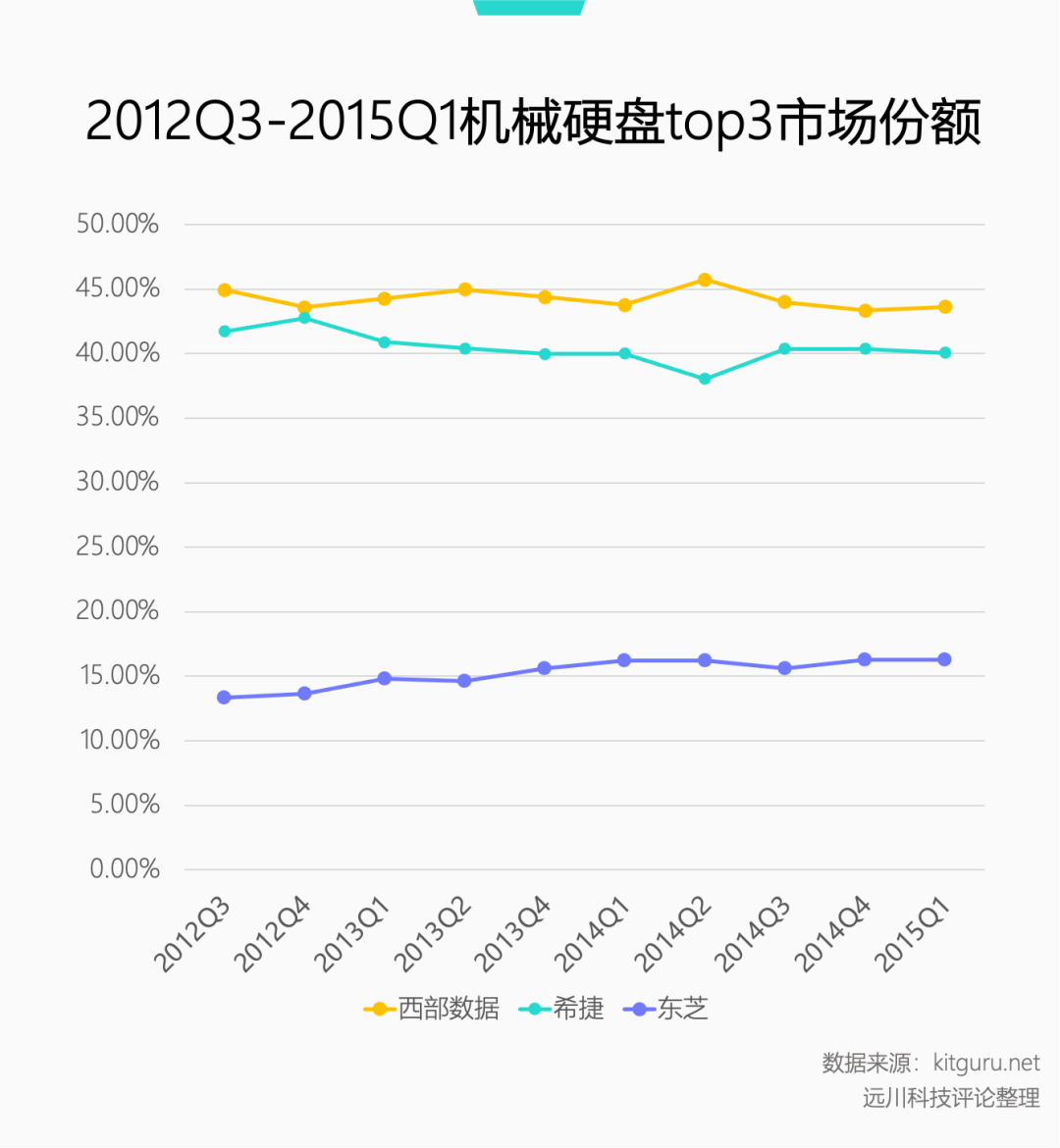
Following this, the HDD market became a sector that lacked both the conditions for “lying flat” and the value for intense competition (“involution”). The so - called lack of conditions for “lying flat” means the inevitable trend of SSDs replacing HDDs is a foregone conclusion; a significant contraction in the latter’s market size is only a matter of time. From 2011 to 2016, HDD shipments dropped from 620 million units to 470 million units, while SSD shipments soared nearly sixfold from 14.6 million units to 102 million units [4].
Compared to HDDs, SSDs are superior in every aspect: they are smaller in size, quieter in operation, and offer an exponential increase in transfer efficiency. The only drawback is their higher price, but production costs are falling rapidly. In 2007, the cost per gigabyte for SSDs was as high as $12[5], dropping to just 3 cents by 2017[6].
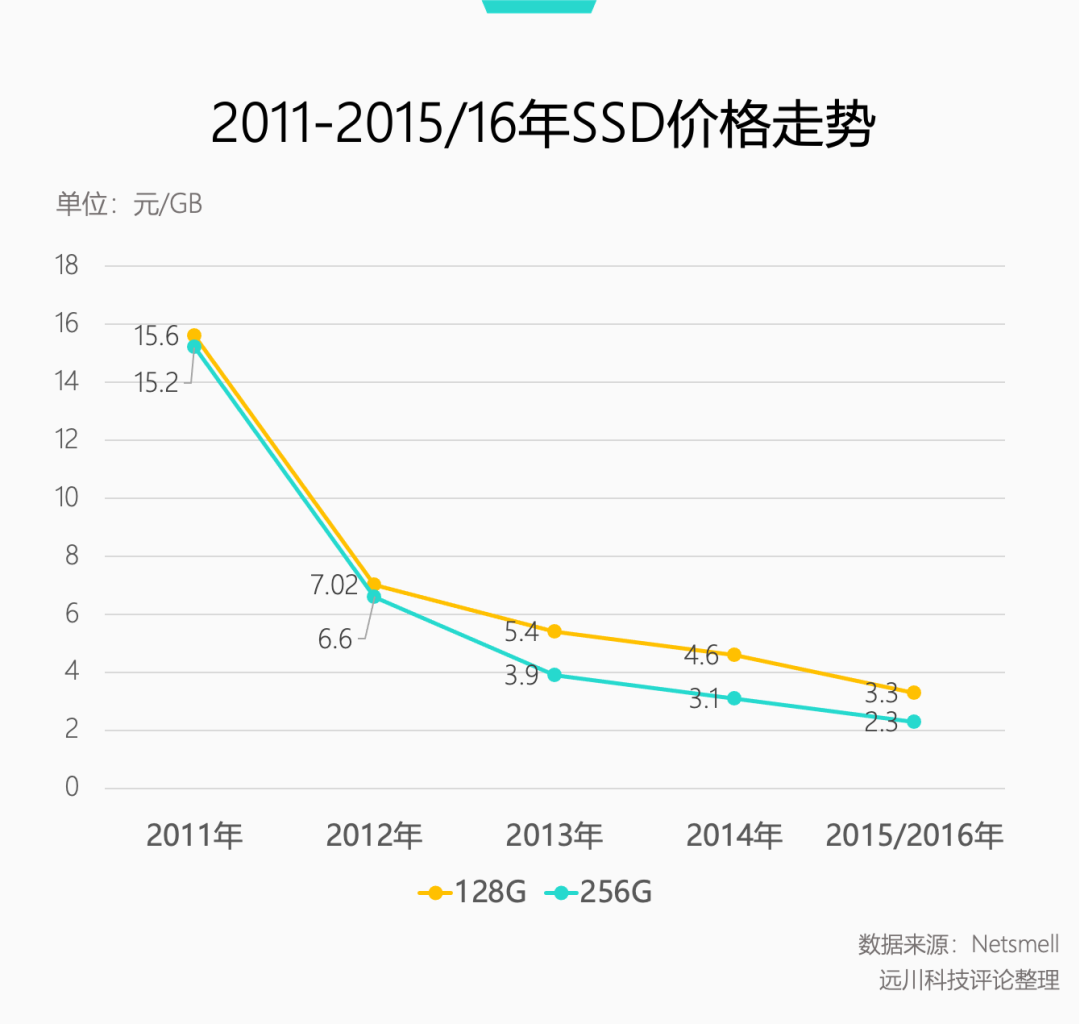
On the other hand, while both are external storage devices, their underlying working principles and manufacturing processes are fundamentally different.
The working principle of HDDs is somewhat similar to that of optical discs: data is recorded by changing the polarity of magnetic materials with read/write heads. SSDs, however, are authentic semiconductor products. They store data by controlling the gate voltage to alter the charge within transistors. Their core components are NAND flash memory chips and controller chips.
For manufacturers, HDDs and SSDs essentially constitute two separate industries, making cross-border integration extremely difficult. Naturally, the two major HDD manufacturers are well aware of this and are both seeking strategic exits.
In 2015, Western Digital made a landmark acquisition of SanDisk for a staggering $15.8 billion, which was nearly ten times its net profit that year ($1.465 billion). This acquisition secured Western Digital with valuable NAND flash memory chip production capabilities. In contrast, Seagate acquired the controller chip company SandForce, but it never gained the ability to manufacture NAND flash memory chips.
Toshiba, on the other hand, has remained relatively calm, as it already possesses its own NAND flash memory chip manufacturing capabilities (now Kioxia) and has successfully broken into the Apple supply chain. Its transformation is therefore on a solid trajectory.
The so-called lack of value for intense competition ("involution") means that the pace of cost reduction for SSDs has gradually slowed down. After years of decline, HDDs have ultimately formed a small but stable market segment, allowing the two major oligarchs, Western Digital and Seagate, to comfortably reduce production and adjust prices.
On the one hand, HDDs have been comprehensively defeated in the consumer market and are now largely supported by the enterprise market, which has strong demand for cold storage. In large-capacity cold storage applications, the cost advantage of HDDs remains unchallenged.
On the other hand, as the pace of cost reduction for SSDs has slowed, the price difference between SSDs and HDDs has stabilized within a relatively fixed range, creating a comfortable, competitive-free zone for HDD manufacturers.
According to Seagate's own estimates, the price ratio per terabyte between enterprise SSDs and HDDs will remain at a long-term level of 7:1[7].
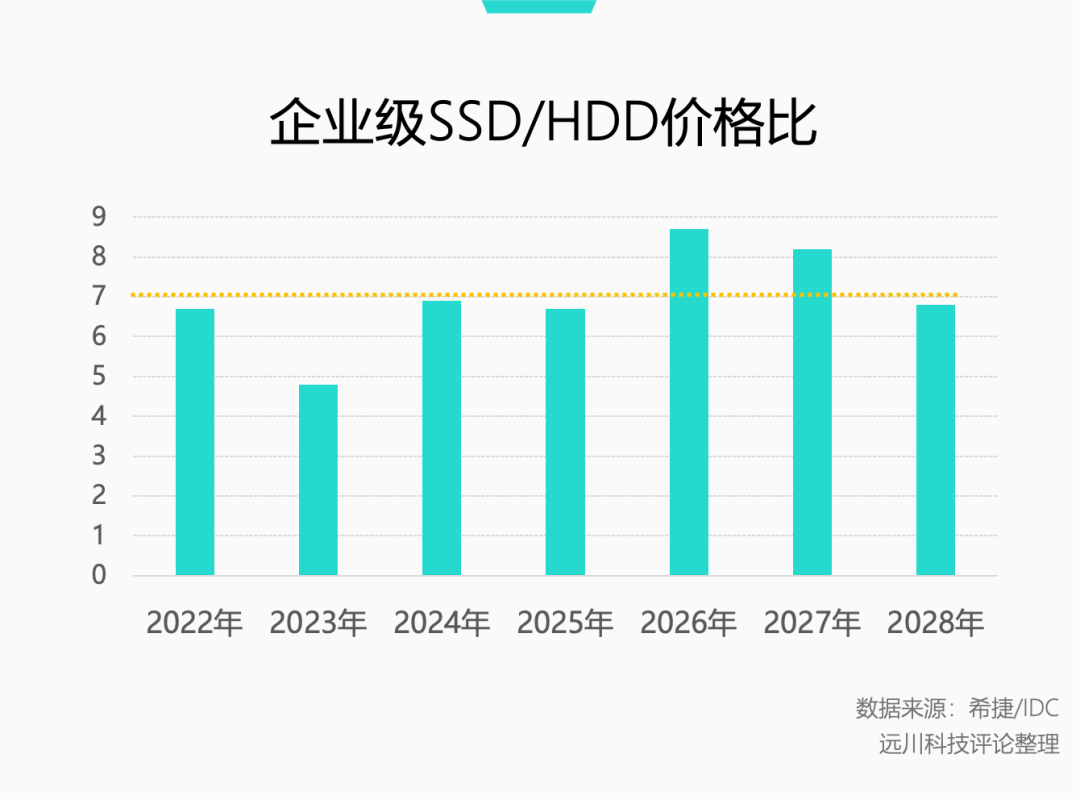
From 2020 to 2025, the revenue share of consumer-grade HDDs in Western Digital and Seagate has quietly declined from over 20% to less than 10%. Seagate's CEO stated that the company hopes to take advantage of this demand environment to maximize profits by controlling supply and optimizing its product mix.
This means increasing investment in data center and enterprise-grade products, while consumers who find consumer-grade products too expensive are welcome to look elsewhere.
03 Victims Alliance
The resurgence of HDDs is merely one abstract link in the broader AI infrastructure boom. The confluence of memory cycles and data center construction has led to a rapid increase in abstract news within the storage market.
According to a report by South Korean media, Samsung Electronics' semiconductor division recently rejected a request from its mobile division to sign a long-term supply agreement, opting instead for quarterly contracts.
The background to this incident is the dramatic price surge in memory chips. LPDDR5X memory chips used in Samsung's flagship smartphones have seen price increases of over 100% this year. Samsung itself possesses memory chip production capabilities and can manufacture them in-house. As a result, the mobile division sought an internal long-term contract to stabilize component prices, only to be 惨遭 (cruelly) rejected by its sibling division [8].
Even Samsung, as a semiconductor giant, is struggling in its mobile division. One can only imagine how difficult the coming year will be for other mobile phone brands.
Similarly, earlier this month, Micron, another major memory chip manufacturer, announced the closure of its consumer-focused storage brand, Crucial, and will completely exit the consumer storage market.
Micron's CEO stated that this "difficult" decision was made to increase supply and support for larger strategic customers. Clearly, these larger customers refer to enterprise and data center giants.
Nvidia is naturally also involved in such matters. With its next-generation data center chip, Grace Blackwell (GB300), entering mass production, it is widely rumored in the industry that Nvidia plans to reduce production capacity for its GeForce RTX 50-series gaming GPUs to make room for the upcoming data center GPUs.
Considering that Nvidia's H100, which cost less than $3,500 to manufacture (BOM cost), could be sold to data center vendors for over $25,000, its pure profit per unit is more than enough to cover the cost of 10 RTX 5090s[9]. It is therefore understandable why Nvidia is shifting its focus.
Looking back ten years, when AlphaGo emerged and AI delivered its first powerful impact on the public, who could have imagined that the future landscape painted by AI would also include price hikes?


 Whatsapp
 Email
Email Skype
Skype