
Hangzhou‘s Chip "Little Giant" is Set for IPO
01. Market share ranks 4th in China and 11th globally. Latest gross profit margin is 10.2%.
Data from the World Semiconductor Trade Statistics (WSTS) shows that in 2024, the global integrated circuit (IC) market reached a size of RMB 3.81 trillion, of which the memory chip market was approximately RMB 1.19 trillion, accounting for 31.3% of the total market. DRAM dominated the memory chip market, with a market size of RMB 697.9 billion in 2024, making up 58.7% of the memory chip market.
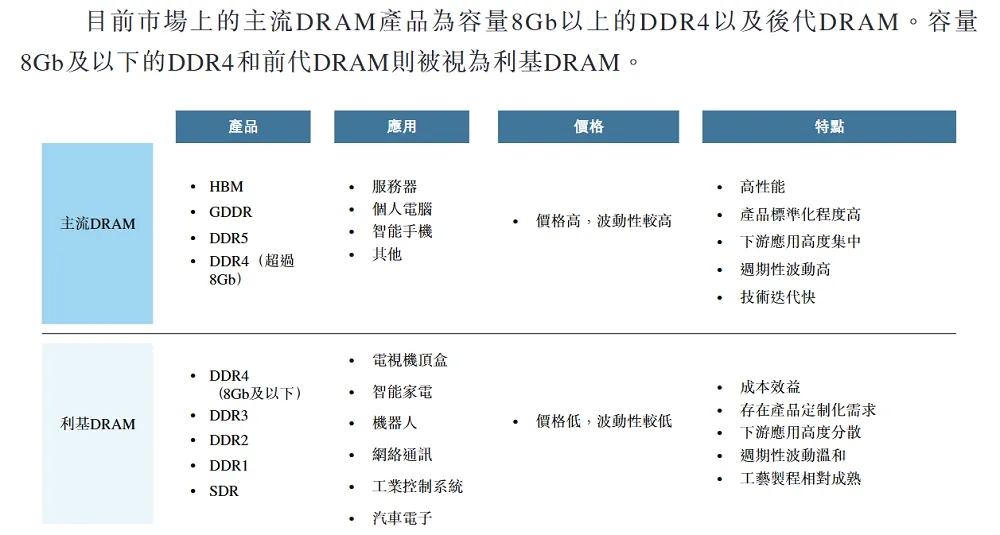
Frost & Sullivan defined the so-called "mainstream DRAM market" and "niche DRAM market (niche refers to a segmented market targeting specific consumer groups)" in its relevant market report.
Mainstream DRAM products feature large capacity and high transmission rates, and are mainly used in large-scale standardized electronic devices such as smartphones, PCs, and servers.
In contrast, niche DRAM has less stringent performance requirements compared with mainstream products and a smaller market scale, but it plays a key role in meeting the market demand of industries such as automotive, communications, and industrial applications. In 2024, niche DRAM products accounted for approximately 8.5% of global DRAM market sales.
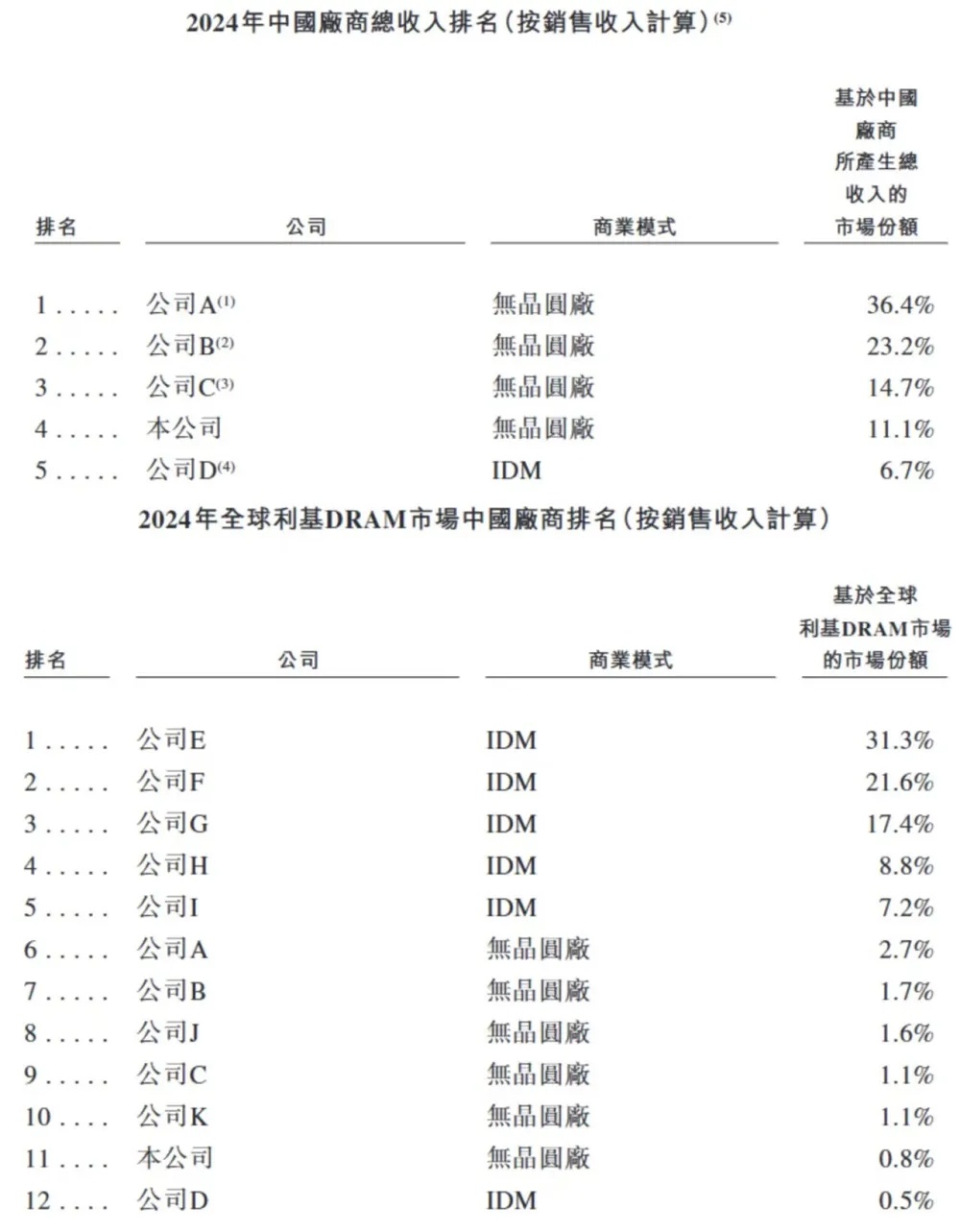
Liji Storage manufactures niche DRAM products. According to data from Frost & Sullivan, in terms of 2024 niche DRAM revenue, Liji Storage ranked 4th among Chinese companies in the global niche DRAM market with a market share of 11.1%; it ranked 11th among all players in the global niche DRAM market with a market share of 0.8%.
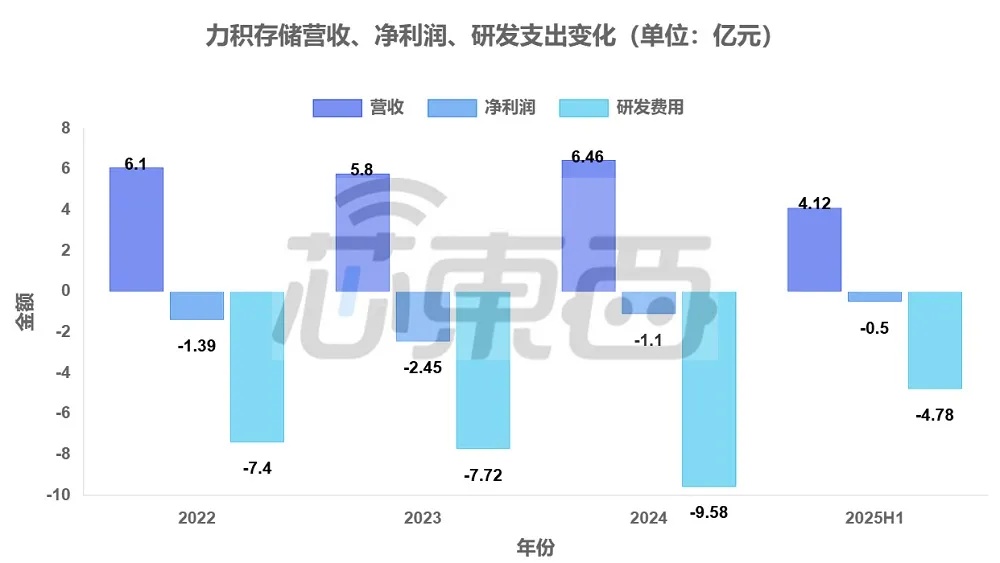
In 2022, 2023, 2024, and the first six months of 2025, Liji Storage recorded revenues of RMB 610 million, RMB 580 million, RMB 646 million, and RMB 412 million respectively; its net profits were RMB -139 million, RMB -245 million, RMB -110 million, and RMB -50 million respectively; and its R&D expenses stood at RMB 740 million, RMB 772 million, RMB 958 million, and RMB 478 million respectively.
During the same period, its gross profit margins were -2.1%, 3.7%, 9.3%, and 10.2% respectively, achieving a turnaround to positive gross profit margin. Liji Storage stated that the negative gross profit in 2022 and low gross profit in 2023 were caused by the downturn in the DRAM industry. At that time, major manufacturers in the niche DRAM industry expanded their production scales, yet the growth in demand in the end market fell short of expectations.
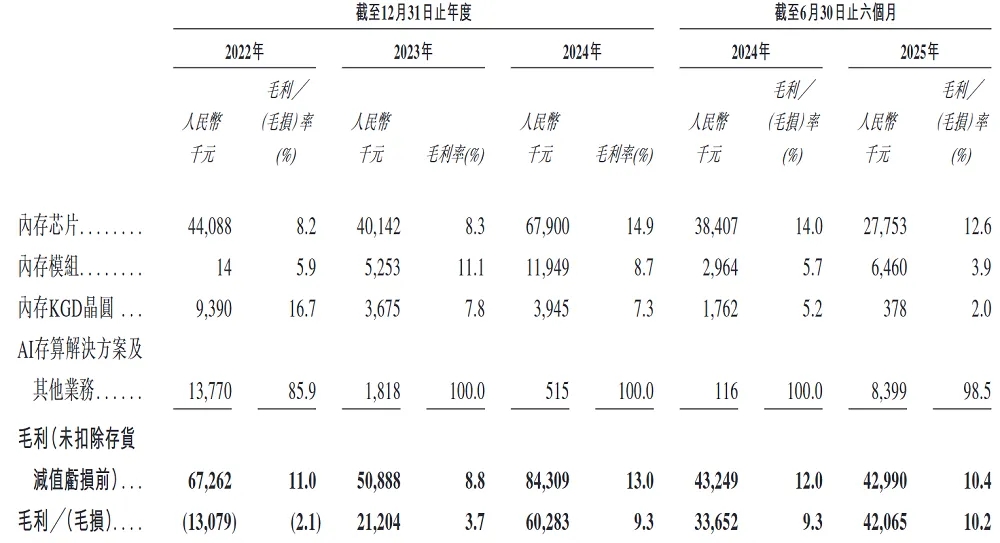
During the reporting period, the main revenue growth of Liji Storage came from the increase in sales of memory modules. Its memory module products contributed revenues of RMB 238,000, RMB 47 million, RMB 137 million, and RMB 165 million respectively, accounting for 0%, 8.1%, 21.3%, and 40.1% of total revenue.
During the same period, Liji Storage's memory chip products contributed revenues of RMB 537 million, RMB 484 million, RMB 454 million, and RMB 219 million respectively, accounting for 88.2%, 83.5%, 70.2%, and 53.3% of total revenue.

In addition, Liji Storage also offers memory KGD wafers, AI memory-computing solutions, and other products. During the reporting period, memory KGD wafer products accounted for 9.2%, 8.1%, 8.4%, and 4.5% of total revenue respectively, while AI memory-computing solutions and other products contributed 2.6%, 0.3%, 0.1%, and 2.1% of total revenue during the same period.
02. Has R&D centers in Hangzhou and Japan; headed by Japanese and Korean technical experts.
Liji Storage has established R&D centers in China, Japan, and other countries and regions. Its Hangzhou R&D department employs 52 team members, led by Kim Jun-ho (Korean nationality), who previously held key positions at SK Hynix, Infineon Technologies, and Winbond Electronics, boasting approximately 30 years of experience in DRAM design and management.
The company's Japan R&D center, with 11 employees, focuses on customized memory products and stacked-structure products such as high-bandwidth memory (HBM). Takashi Kubo (Japanese nationality), the overall business director of the Japan R&D center, previously served as a senior engineer at Mitsubishi Electric and Renesas Electronics, where he oversaw process development and mass production for multiple products and accumulated over 25 years of DRAM R&D experience.
Most of Liji Storage's core technical personnel are from renowned semiconductor companies such as SK Hynix, with years of relevant experience. As of June 30, 2025, the total number of R&D personnel reached 78, accounting for approximately 51.7% of the company's total workforce, and all R&D staff hold at least a bachelor's degree.
As of November 21, 2025, Liji Storage owned 80 patents (including 71 in China and 9 in Japan), 31 trademarks (including 23 in China, 4 in Hong Kong, 1 in Macao, 1 in Taiwan of China, and 2 in Japan), 10 copyrights in China (including 7 software copyrights), and 11 integrated circuit (IC) layout designs.
Liji Storage's key intellectual property (IP) and technologies include 8GB DDR4, 25nm 1GB DDR3, 25nm 2GB DDR3, high-bandwidth memory (HBM), and 8GB DDR4 logic process product design, among others.
03. High customer concentration
Major suppliers are also shareholders.
Liji Storage's customers are mainly distributed across industries such as consumer electronics, network communications, automotive electronics, energy, and industrial control equipment. For the three years ended December 31, 2024, and the six months ended June 30, 2025, its revenue from the top five customers was approximately RMB 390 million, RMB 388 million, RMB 336 million, and RMB 210 million respectively, accounting for about 64.0%, 66.8%, 52.0%, and 51.0% of the total revenue for each period.
In 2022, all of Liji Storage's top five customers were memory chip purchasers, but in the subsequent years, the number of memory module purchasers among the top five customers gradually increased. Among them, Nanhai Group, with operations in Shenzhen and Hong Kong, became Liji Storage's fifth-largest customer in 2023 and rose to the first position in 2024, with sales to the group increasing from RMB 36.1 million in 2023 to RMB 87.5 million in 2024.
Liji Storage established a business relationship with Nanhai Group in 2023, which is one of the strategic initiatives of the former to expand its memory module business by introducing new distributors with sales capabilities in relevant fields. The memory modules sold through Nanhai Group are mainly applied in downstream sectors such as consumer electronics, servers, and desktop computers, a move that has deepened Liji Storage's penetration in mainstream downstream applications.
Powerchip Semiconductor Manufacturing Corporation's primary suppliers include the following two categories: production partners, which encompass wafer fabrication service providers and packaging and testing service providers; as well as other raw material suppliers.
During the reporting period, Powerchip’s procurement from its top five suppliers amounted to approximately RMB 672.8 million, RMB 475.9 million, RMB 451.1 million, and RMB 282.9 million, accounting for about 97.0%, 88.6%, 76.2%, and 77.5% of the total procurement in each respective period. This reflects a relatively high concentration of suppliers.
To the knowledge of the directors, apart from Powerchip Semiconductor Manufacturing Corp., none of Powerchip’s directors, their associates, or any major shareholders holding more than 5% of the issued share capital have any interests in the aforementioned major customers or suppliers that require disclosure under the listing rules.
04. Founder Holds 44.6% Direct Stake, Received RMB 114 Million in Remuneration in 2023
Liji Storage's equity structure is as follows:
The summary of its previous financing rounds is as follows:
Ying Wei serves as both the legal representative and actual controller of Lyu Storage Technology Co., Ltd., with a direct equity stake of 44.6%. The controlling shareholders consist of Ying Wei and his affiliated entities.
Ying Wei, 59 years old, was appointed as Director and Chairman of the Board in November 2020. With effect from May 23, 2025, he was re-designated as Chairman of the Board and Non-Executive Director, primarily responsible for formulating corporate and business strategies, as well as overseeing the company’s management and strategic development.
Furthermore, Ying Wei has long held key positions in the semiconductor design and investment sectors. Since December 2021, he has served as a Director of Nanjing Tianyi Hexin Electronics Co., Ltd., which is engaged in the design of sensor chips and analog chips.
In the field of investment management, he has served as the Director and General Manager of Shenzhen CDH Baifu Private Equity Investment Fund Management Co., Ltd. since May 2018, as a Director of Shanghai Dingcheng Private Fund Management Co., Ltd. since March 2018, as the Director and Executive Managing Partner of Shanghai CDH Baifu Investment Management Co., Ltd. since December 2014, and as the Executive Managing Partner at CDH Investments Management (Hong Kong) Limited since April 2009.
Over the past three years, Ying Wei has also held directorship roles in multiple companies listed on the Hong Kong Stock Exchange, the Shenzhen Stock Exchange, the Shanghai Stock Exchange, and NASDAQ.
In the fiscal years ending December 31, 2022, 2023, and 2024, the total remuneration for the directors of Powerchip Semiconductor Manufacturing Corporation was RMB 0, RMB 118.2 million, and RMB 10.3 million, respectively. According to current projections, the total director remuneration for the 2025 fiscal year is expected to remain at approximately RMB 10.4 million.
Among the five highest-paid individuals over the years, no directors were included in the 2022 fiscal year. However, in both 2023 and 2024, two directors were listed among the top five highest-paid individuals.
Additionally, the total remuneration paid to non-director members among these five highest-paid individuals amounted to RMB 7.9 million, RMB 37.7 million, and RMB 20.4 million for the fiscal years 2022, 2023, and 2024, respectively.
Notably, in 2023, Powerchip Semiconductor Manufacturing Corporation paid a total remuneration of RMB 114 million to Ying Wei, which included RMB 85.957 million in shares.
05 Conclusion: Self-Sufficiency Rate of Domestic DRAM Continues to Rise
The primary drivers of DRAM industry growth stem from the continuous development and technological upgrading of downstream application sectors. On one hand, traditional fields such as consumer electronics, automotive, and industrial sectors maintain steady demand, while emerging scenarios including AI, smart wearables, and humanoid robots have significantly expanded the market space for high-performance DRAM.
On the other hand, applications like cloud computing, smartphones, and intelligent driving are imposing increasingly higher requirements on memory capacity and bandwidth, driving the iteration of DRAM toward higher capacity and higher bandwidth.
In terms of technological innovation, high-bandwidth stacked DRAM has emerged as a critical pathway to breaking performance bottlenecks and meeting the computing demands of AI. Furthermore, supported by policy incentives and the trend toward supply chain localization, Chinese enterprises such as Lyu Storage are accelerating technological R&D and market penetration. Looking ahead, the self-sufficiency rate of domestic DRAM is expected to maintain a steady upward trajectory.


 Whatsapp
 Email
Email Skype
Skype